




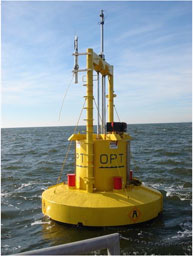
Construction of the first wave-power farm in America has recently begun off the coast of Oregon. New Jersey-based Ocean Power Technologies is in the process of installing ten wave-power harnessing buoys that they say will be able to power 400 homes.
Wave power is still a very young technology, and is therefore much more expensive at this point than more established renewable energy options such as wind and solar. Costs can be up to six times greater than wind, and this one project is expected to cost around sixty million dollars. However, as time goes on and wave-power projects become more common and costs fall, there is potential for the technology to produce an almost unlimited stream of clean energy. Just think, while weather changes often, waves are much more consistent.
So, how exactly does a wave-power farm work? A series of large buoys are placed in an area of ocean with lots of wave activity. Each buoy has a float that rises and falls along with the water surface, driving a plunger up and down. That plunger’s vertical energy is then converted into rotary motion and produces electricity by spinning a generator. The resulting electricity is then sent on shore through an underwater cable.
Wave-power has always fascinated me and it’s great to see it finally becoming a reality. I love how diverse the green energy industry is, with power coming from wind, solar, geothermal, biomass, and now waves. What will be next?
Image Via OPT