Natural Gas Deregulation

The Recent History of Natural Gas Deregulation
The structure of the natural gas industry has changed dramatically over the past 20-25 years. Prior to that time, the industry structure was simple, with limited flexibility and few options for natural gas delivery. Exploration and Production companies explored and drilled for the gas, and sold it at the wellhead to large transportation pipelines. The pipelines then transported gas to a local distribution company (LDC), who distributed and sold gas directly to end users. Essentially, the supply, transmission and distribution of natural gas was handled by local utility companies.
The relatively low rates for natural gas set in the early 50's were well below the market value, and demand surged over the next two decades. Unfortunately, gas companies weren't inclined to search for additional gas reserves due to the low selling price of natural gas. The eventual supply shortages led Congress to legislate the Natural Gas Policy Act in 1978.
The gradual climb toward deregulation began with the Natural Gas Policy Act, and the removal of price ceilings at the gas supply's source—the wellhead.
Since then, due to a number of regulatory changes mandated by the Federal Energy Regulatory Commission (FERC), the market has significantly changed and is much more open to competition and choice. As of January 1, 1993, price regulations at the wellhead were eliminated. Customers are now able to choose who supplies their natural gas, but the transmission and distribution of natural gas is still regulated, meaning the price for these two services are maintained and set by both state and federal tariffs.
What This Means for You—the Consumer
Thankfully, natural gas marketers are providing several options in either bundled or unbundled packages, meaning you have plenty of options when it comes to product and pricing. Bundled packages were the standard before deregulation allowed an LDC to sell natural with all applicable sales, storage, transmission, delivery and any additional fees separately. Prior to deregulation, the consumer paid for all fees together, giving little wiggle room in pricing.
|
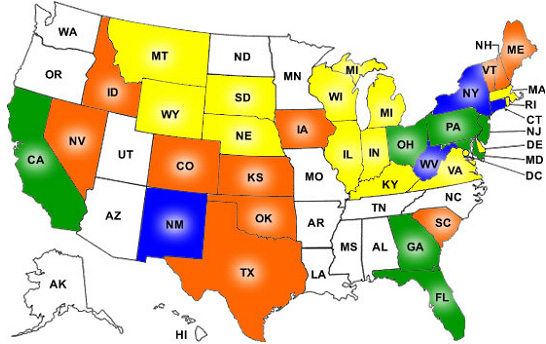
These states have fully implemented a competitive natural gas market and all non-residential customers are eligible for customer choice. |
||
|
|
These states have begun implementing a competitive natural gas market. |
|
|
|
These states have either established a timeline for implementing restructuring, or are offering pilot programs for some customers. |
|
|
|
These states are currently pursuing legislation, regulations, or programs to implement natural gas restructuring. |
|
|
|
In these states, unbundled service is only available to large commercial and industrial customers. Unbundled service is available for large commercial and industrial customers in every state. Restructuring for small commercial and residential customers is varied throughout the states. |