COMPARE RATES FOR ESSENTIAL HOME SERVICES

Street Address:
Apt/Suite:
Zip Code:

Natural Gas and Electricity News Archives

« Moving Tips | Main | News »

Live Smart: Choose Green Energy Today

Go Green Today!

The recent relaunch of GreenEnergyChoice.com gives energy customers new options for purchasing renewable energy for their homes, powered by the clean and efficient Mother Nature. Wind, solar, water power and more help generate pollution-free energy for your home, with the added benefits of researching, comparing and ordering online to help you save time and money.

In addition to an easy and fast ordering process and competitive rates on green energy from leading energy providers, the Green Guide and Green Blog offer tons of tips and information on living green, what is green, global warming and more. For more information on greenifying your life, please go to GreenEnergyChoice today.

Direct Energy Service Now Available!

Direct Energy Service Added to WhiteFence Network

Exciting news in the world of Texas deregulated electricity providers in the WhiteFence network. We are enthused to announce another provider, Direct Energy, to the constantly growing electricity and natural gas services available at sites such as ElectricityTexas.com. Being the third largest competitive energy retailer in Texas, they are able to provide competitive rates and plans to millions of customers, with innovative products such as price protection that helps alleviate concerns over rising rates in peak seasons (summer and winter).

Along with powering your home with electricity, Direct Energy also takes initiatives in saving the planet by seeking out alternative energy sources and creating choices for their customers. The commitment they have taken to preserve our environment and lightening the load on your checkbook keeps them on pace in this world as a force in the Texas electricity market.

Direct Energy Signs Deal to Increase Wind Portfolio

What is to be one of the largest wind farms constructed by AES Corp. in the U.S.—Abilene's Buffalo Gap 3 and its 524 megawatt capacity— will help Houston-based utility Direct Energy add 170 megawatts to its current wind portfolio. Operations are expected to begin in mid-2008 as part of the new seven-year deal between AES and Direct Energy.

"The Buffalo Gap 3 expansion will allow AES to continue developing renewable energy sources in West Texas, benefiting the local economy through the creation of new jobs and an increased tax base," said Ryan Pfaff, Managing Director, AES Wind Generation. "We are also pleased to further expand our relationship with Direct Energy, a world-class organization that shares our commitment to the West Texas wind market."

Direct Energy's total renewable energy purchases will increase to 813 megawatt with the new agreement—enough to power 200,000 Texas homes and offset nearly 2 million tons of carbon dioxide emissions annually.

For more information on the AES/Direct Energy agreement, please see the AES press release.

Phoenix Mayor, SRP, APS Kick Off Lighting Campaign

The City of Phoenix, SRP (Salt River Project) and Arizona Public Service (APS), Arizona's largest electricity provider, recently implemented a program to offer residents energy efficient ENERGY STAR's qualified compact fluorescent lamps (CFLs) in their homes.

Through APS' ENERGY STAR Lighting Program, more than three million bulbs have been sold, saving more than $90 million in energy costs and reducing carbon emissions by 675,000 tons. Through the APS Lighting Program, the discounted bulbs are available at more than 400 local retail locations statewide and at more than 50 Phoenix locations. With the APS discount, the bulbs are available for less than one dollar each. Recently, APS was named 2007 ENERGY STAR Partner of the Year by the U.S. Department of Energy and the Environmental Protection Agency for its lighting program.

Tammy McLeod, APS general manager, Customer Service & Operations said, "Partnerships such as this have bottom line, immediate benefits for residents and the environment. We're proud to join our Phoenix partners to expand this effort. A little bulb really does make a big change. Today, APS is committing to offering discounts on an additional one million CFLs through the end of the year."

Please see the APS press release for more information

ComEd Prepares for Heavy Weekend Demand for Electricity, Offers Energy-Saving Tips

ComEd Prepares for Heavy Weekend Demand for Electricity, Offers Energy-Saving Tips High temperatures have been forecasted this weekend for Chicago and Northern Illinois. To prepare for the heavy electricity demand, ComEd is taking additional measures to ensure service reliability.

Part of the preparation includes postponing scheduled work that would require equipment to be out of service and scheduling extra work crews, where appropriate, to handle any problems that may occur. They will also be putting work crews in the field to monitor the system and respond quickly to any problems.

ComEd says it will closely monitor its electric system throughout the weekend and remain in contact with area public officials should any potential problems arise.

To help customers stay comfortable, conserve energy and manage electricity bills during the weekend heat wave, ComEd also offers the following energy-saving steps that they say can save up to 15 percent on home energy costs:

  • Keep thermostats at a constant, comfortable level (75 - 78 degrees) when at home. Lowering the thermostat setting below the desired temperature will not cool the home faster.
  • To reduce heat and moisture during the warmest part of the day, run appliances such as ovens, washing machines, dryers and dishwashers in the early morning or evening hours when it's generally cooler outside. Also, use a microwave to cook, or barbecue outside, if possible.
  • Keep shades, blinds and curtains closed. About 40 percent of unwanted heat comes through windows. Simply drawing blinds and curtains, which act as a layer of insulation, can reduce heat gain to your home. Awnings are even better, and can reduce heat gain by up to 75 percent. Window coatings and window film can reflect as much as 80 percent of direct rays from the sun.
  • Turn off all unnecessary lighting and appliances, which add heat to the home.
  • Keep doors to the outside, garage or attic firmly closed to keep cool air in and hot air out.
  • Use fans to evenly distribute cool air and reduce the air conditioners "on" time.

For more energy-saving ideas, visit www.ComEdCARE.com.

Energy Efficient Homes Gaining Popularity and Producing Savings

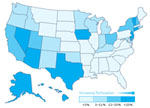
Energy Efficient Homes Gaining Popularity and Producing Savings Are you thinking about upgrading to a more energy-efficient home? Depending on what state you live in, finding one might be easier than ever before. In 2006, the percentage of newly constructed single family homes earning the government's ENERGY STAR for superior energy efficiency exceeded 12 percent in 15 states. The 15 leading states are: Alaska, Arizona, California, Connecticut, Delaware, Hawaii, Iowa, Nevada, New Hampshire, New Jersey, New York, Ohio, Texas, Utah and Vermont.

"Consumers don't have to limit their smart energy choices to energy-efficient cars and appliances," said Bob Meyers, EPA's principal deputy assistant administrator for Air & Radiation. "EPA is pleased to see builders in so many states leading the effort to offer their customers high-efficiency, low-emission choices in new homes."

The EPA says that nearly 200,000 new homes nationwide earned the ENERGY STAR in 2006, bringing the total number of ENERGY STAR qualified homes across the nation to almost 750,000. They also estimate that these homes have provided an annual savings of more than $180 million for homeowners by saving over 1 billion kWh of electricity and 100 million therms of natural gas.

To earn the ENERGY STAR, homes must be independently verified as meeting EPA's strict guidelines for energy efficiency. At least 15 percent more energy efficient than homes built to the 2004 International Residential Code, ENERGY STAR homes include additional energy-saving features that typically make them 20 to 30 percent more efficient than standard homes.

Home energy use accounts for nearly 17 percent of the total U.S. greenhouse gas emissions and 21 percent of energy consumption nationwide. In 2006, Americans, with the help of ENERGY STAR, saved $14 billion and prevented greenhouse gas emissions equivalent to those from 25 million vehicles.

To see if there are ENERGY STAR homes available near you, check out the ENERGY STAR Qualified New Homes Market Indices for States.

PC Energy Report: Shutting Down Your Work PC Makes a Big Energy Impact

PC Energy Report: Shutting Down Your Work PC Makes a Big Energy Impact According to a recent survey released by 1E and the Alliance to Save Energy, nearly half of all corporate PCs in the United States are not regularly switched off at night. This means a conservative estimate of 31.2 million work PCs are being left on overnight; wasting energy, putting carbon emissions into the air, and costing US businesses $1.72 billion to supply power to machines that are not even in use.

All these PCs being left on overnight is also pumping 14.4 million tons of carbon dioxide (CO2) into the atmosphere. According to recently released PC Energy Awareness report, preventing that amount of CO2 from reaching the atmosphere would have roughly the same impact as taking 2.58 million passenger cars entirely off the road—more cars than exist in the entire State of Maryland (2.48 million cars).

The recent report combines statistics on energy usage and CO2 emissions, alongside research on behavior in the American workplace—such as whether employees are turning their PCs off at the end of the day (why or why not).

1E, a provider of power management software, and the Alliance to Save Energy, a coalition of businesses, government, environmental and consumer leaders who promote the efficient and clean use of energy around the world, commissioned the survey with market research firm Harris Interactive, to examine PC power usage in the American workplace.

For more information, check out the 1E Energy Awareness Campaign Web site.

ComEd Reminds Customers to Apply for Rate Relief, Offers Energy Saving tips

ComEd Reminds Customers to Apply for Rate Relief, Offers Energy Saving tips As temperatures in Illinois continue to climb, ComEd is reminding customers to apply for help with summer electric bills through ComEd's $64 million Rate Relief and Assistance Initiative. ComEd says it has already granted more than $15.4 million in bill credits to about 350,000 customers, and nearly $30 million remains available to eligible customers this year.

The company says rate relief grants, credits and other programs are available now to customers most in need. For most programs, customers with incomes up to 200 percent of the poverty level, or $40,000 for a family of four, qualify. In addition, a residential special hardship fund is open to families with incomes up to 400 percent of the poverty level, or $80,000 for a family of four. Enrollment is now open, and ComEd is encouraging all customers who think that they may be eligible to apply.

ComEd also is increasing its work crews in the field today to monitor the system and respond quickly to any problems. ComEd says it cannot promise there will never be outages, but is committed to reducing their number and duration by responding quickly to any service interruptions that may occur. If customers experience an outage or have any questions about their ComEd service, they are urged to call 1-800-EDISON-1 (1-800-334-7661).

ComEd is also offering energy saving tips to help customers reduce their energy use and lower their bills:

  • While at home, keep the thermostat at a constant, comfortable level (a suggested 75 to 78 degrees). Lowering the thermostat below the desired temperature will not cool the home faster.
  • Run appliances such as ovens, washing machines, dryers and dishwashers in the early morning or evening hours when it's cooler.
  • Keep shades, blinds and curtains closed. About 40 percent of unwanted heat comes through windows. Blinds and curtains act as a layer of insulation that helps keep the home cool.
  • Keep doors to the outside, garage or attic firmly closed to keep cool air in and hot air out.
  • Use fans to evenly distribute cool air and reduce air conditioners "on" time.
  • Place window air conditioning units on the north or shady side of the home to avoid overworking the unit in the hot daytime sun.

For more energy-saving ideas, or for more details on ComEd's Rate Relief and Assistance Initiative, visit www.ComEdCARE.com, or call 888-806-CARE (2273).

Duke Energy Ohio to Seek Increase in Natural Gas Base Rates

Duke Energy Ohio to Seek Increase in Natural Gas Base Rates Duke Energy Ohio recently announced it will file an application with the Public Utilities Commission of Ohio seeking an increase of $34 million, or 5.8 percent overall, in natural gas rates. The increase would be effective in the early- to mid-2008 and is the first general rate filing since 2001.

Duke Energy Ohio says it has invested more than $460 million to expand its natural gas delivery system to meet customer growth and make other safety, reliability and efficiency improvements. In addition to that investment, the company says it has also experienced increases in operating costs for delivery service consistent with inflation, creating the need for a rate increase.

"We have made significant investments in our natural gas system to meet customer growth and improve safety and reliability," said Sandra Meyer, president of Duke Energy Ohio. "These investments have enhanced service and reduced maintenance expenses, helping to minimize the requested increase."

The company is seeking to implement the increase for residential customers over a three-year period to gradually establish rates for all customers that reflect the actual cost of providing service. The actual amount of the bill will depend on the cost of natural gas at the time the increases take effect and the level of increase authorized by PUCO. Natural gas costs are billed to customers at the company's cost or at the customer's agreed upon price with an alternative supplier, in either case without profit to Duke Energy Ohio.

Duke Energy Ohio is planning to increase its funding for low-income weatherization by 50 percent to assist customers in managing their energy usage.

For more on the rate increase, see the Duke Energy Ohio press release.

DOE and Disney Join Forces to Promote Energy Savings

DOE and Disney Join Forces to Promote Energy Savings Having a hard time convincing your kids to adopt good energy-saving habits? If you could use a little help, the U.S. Department of Energy (DOE) and Disney recently announced that they are cooperating in a nationwide campaign to promote energy efficiency through a TV spot based on the upcoming film Disney*Pixar film Ratatouille. Energy advice from a rat that cooks? It just might work!

"Combining the energy expertise of the Department of Energy with the promotional ingenuity of Disney is a unique way to raise energy awareness," said DOE Secretary Samuel W. Bodman. "I hope this will be the first project in a continuing effort to leverage the resources of the entertainment industry and government to encourage smart energy choices."

Featuring the Ratatouille characters Remy, Emile and Skinner, the 30-second animated spot encourages viewers to switch from incandescent light bulbs to EnergyStar® compact fluorescent lighting (CFL) and points them to the energy.gov website for more tips on saving energy or using renewable energy technologies in the home.

Beginning June 15, the spot will air on cable networks nationwide, with a particular emphasis in northern portions of Virginia as well as in northern and southern California, and will continue through the summer. While the spot points out that energy can be used in a variety of ways, it emphasizes that it can be used more efficiently by employing technologies such as CFLs.

To view the spot and get tips on saving energy visit www.eere.energy.gov/consumer.

ComEd Says It's Ready for Summer

ComEd Says It's Ready for Summer ComEd officials recently announced that the company has informed the Chicago City Council Committee on Environmental Protection, Energy and Public Utilities at its annual summer readiness briefing that the company is well positioned to meet summer electricity demand.

ComEd President J. Barry Mitchell confirmed ComEd has sufficient resources in place to meet customer demand and fulfill its 15 percent reserve margin requirement under the PJM Regional Transmission Organization, which manages the electricity grid in all or parts of 13 states and the District of Columbia. Mitchell expects peak demand for electricity this summer could reach 23,525 megawatts (MW), less than last summer's all-time record of 23,613 MW set Aug. 1, 2006. One MW powers approximately 300 homes equipped with air conditioning and modern appliances.

"ComEd is prepared both in terms of energy supply and system reliability," Mitchell said. "Our system performed outstanding during last year's record period, and we are poised as always to meet customer needs—even on the hottest days."

ComEd says it is continuing to invest in its infrastructure to enhance reliability and meet growing customer demand. The company says that since 2000, it has invested about $4.7 billion to enhance its electric distribution system throughout the northern Illinois service territory—with $264.4 million invested in 2006.

"We performed 107 summer critical projects in Chicago to bolster reliability and system capacity ahead of the coming summer," Mitchell said. "In addition to installing new distribution lines and extending existing lines, we conducted numerous drills and carried out preventive and corrective maintenance to prepare our personnel and equipment for the coming summer."

For more information on ComEd's plans for the summer season, check out the press release.

NSTAR Enhances Customer Service Experience With AT&T; VoiceTone

AT&T; Inc. recently announced the successful implementation of a voice solution for NSTAR, a Massachusetts-based electricity and natural gas utility, to manage incoming customer service calls. Under a $3 million four-year contract, AT&T; will provide NSTAR with AT&T; VoiceTone®, a natural-language solution that responds to customers' precise needs.

AT&T; says VoiceTone is designed to enhance the customer-calling experience by replacing time-consuming menus and touch-tone prompts with conversational interactions. Customers ask questions, make requests and receive accurate, natural-voice responses. The system closely resembles a live agent with its ability to quickly understand callers' specific needs and to direct them to the correct customer service representative.

"Providing our customers with support that is easily accessible, accurate and efficient is extremely important to us," said Gene Zimon, NSTAR's Chief Information Officer. "AT&T;'s VoiceTone is an innovative solution that not only enables us to better serve and build stronger relationships with our customers but also creates cost-reducing efficiencies throughout our customer service department."

AT&T; VoiceTone also creates efficiencies within NSTAR's customer service centers. The system increases the likelihood that callers are directed to the correct service department or self-service option on the first connect, reducing the amount of time spent with each customer without compromising service. In addition, AT&T; VoiceTone increases NSTAR's call capacity and allows more customer needs to be answered during peak calling times without increasing the number of representatives.

Fore more information, check out the AT&T; press release.

NERC: Reliable Electricity This Summer, Barring Extreme Weather

NERC: Reliable Electricity This Summer, Barring Extreme Weather Electricity capacity is expected to be able to ensure reliable electric service throughout North America this summer, under normal summer weather conditions, according to Rick Sergel, president and CEO of the North American Electric Reliability Corporation (NERC). However, widespread and sustained hot and humid weather could threaten that reliability. NERC will release this and other conclusions in its 2007 Summer Assessment.

"The numbers tell us we will be OK, but the weather has been challenging in recent years. If areas of North America experience extended periods of extreme weather this summer, utilities may need to implement emergency procedures to reduce customer demand," said Rick Sergel, president and CEO of NERC.

In summer 2006, when extreme weather was experienced across much of North America, some utilities issued emergency alerts and public appeals, implemented voltage reductions, and exercised contracts with customers that allowed them to interrupt electricity supply in return for lower rates. All these actions helped keep supply and demand in balance and maintained the reliability of the bulk power system.

Extreme weather can impact the electricity grid in numerous ways. Higher demand for electricity, mainly from air-conditioning, stresses the electricity supply and delivery system. Generating units cannot be cooled as easily so their output has to be reduced to maintain appropriate operating temperatures. The amount of electricity flowing over transmission lines must be limited during extreme heat to prevent excessive line sagging and damage.

Several issues highlighted in NERC's Long-term Reliability Assessment issued in October 2006 are being addressed. The amount of demand represented by customer Interruptible Demand and Direct Control Load Management programs increased since last year by more than 10 percent in Florida, 13 percent in other parts of the southeastern United States, and almost 20 percent in the western United States and Canada. Many regions are studying the interdependence of fuel delivery and reliability, and improving coordination between fuel suppliers and generators.

For more information, see the NERC Web site.

New Yorkers Can BE COOL with Air Conditioner Incentives

New Yorkers Can BE COOL with Air Conditioner Incentives This summer the New York State Energy Research and Development Authority's (NYSERDA) BE COOL campaign is making it easier for New Yorkers to save energy. Single- and multi-family residential customers of Con Edison electric service in New York City and Westchester County who turn in an old, working room air conditioner and purchase a new ENERGY STAR qualified model can earn a financial reward. Those turning in a window-based room air conditioning unit may earn $35 for each unit and those turning in a through-the-wall air conditioning unit may earn $100 for each unit when they purchase a new ENERGY STAR model.

Residents just need to bring their old unit to an authorized drop off site or retailer location, where the units will be properly recycled and residents will receive a mail-in application for the incentive. Managers of multi-family buildings may contact NYSERDA directly to complete a change-out of all the units in their building.

The savings to New York City residents go far beyond the initial incentive. According to the U.S. Environmental Protection Agency (EPA), the average family spends $1,900 a year on energy bills, nearly half of which goes to cooling and heating. Additionally, ENERGY STAR qualified room air conditioners use 10 to 25 percent less energy than a conventional new model or up to 40 percent less energy than a 10-year-old unit. Additionally, ENERGY STAR qualified room air conditioners often include timers or programmable thermostats for better temperature control, allowing residents to use the minimum amount of energy needed to cool a room, and to cool the room only when it's really needed.

"NYSERDA's BE COOL campaign represents a huge opportunity for New Yorkers to reduce both their energy use and carbon dioxide emissions, as well as save money," said Peter R. Smith, president and CEO of NYSERDA. With just a few simple changes, New Yorkers can use their air conditioners without wasting energy. It's really the way to 'be cool' this summer."

"Con Edison customers can keep cool this summer and help reduce pollutants by properly recycling their old air conditioners and buying ENERGY STAR qualified air conditioners," said Rebecca Craft, director of energy efficiency programs for Con Edison. "ENERGY STAR qualified appliances use energy efficiently and the BE COOL reward is an added incentive."

New Yorkers who are not eligible for the incentive can still save energy during the summer by using timers on air conditioners and lights; closing shades or curtains on windows that receive direct afternoon sun; using ENERGY STAR compact fluorescent light bulbs (CFLs) instead of wasteful, heat- generating incandescent bulbs; and always looking for the ENERGY STAR when purchasing appliances and air conditioning products. Also, by shifting energy-intensive tasks such as dishwashing and clothes washing to cooler early morning or late night hours, New Yorkers can help reduce mid-afternoon heat build-up and make sure there is enough electricity for everyone during the hottest part of the day.

The message is hip, but the results are serious. According to the U.S. Environmental Protection Agency (EPA), if one out of 10 families in the United States used cooling and heating equipment that has earned the ENERGY STAR, the change would keep more than 17 billion pounds of pollution out of the air. Additionally, properly sizing new units, recycling old ones and taking simple steps to be more energy efficient at home increases the savings.

"The New York Power Authority's energy efficiency programs, on behalf of its public sector partners, have contributed to significant energy savings across the state. Working with NYSERDA, New York City and Con Edison to provide consumers with the tools to save energy in the home will have a positive effect this summer," said Timothy S. Carey, president and CEO of the New York Power Authority.

NYSERDA is also coordinating with New York City's plaNYC effort to make New York City more sustainable and plan for the year 2030.

"I urge all New Yorkers to take advantage of these programs to make saving energy even more cost-effective," said Mayor Michael R. Bloomberg. "By taking these easy steps in their homes, New Yorkers can lower electricity bills, help prevent blackouts, and help prevent climate change. Helping consumers save energy is a key component of our plaNYC effort to build a greener, greater New York, and we are proud to be working with NYSERDA on this program."

Visit www.GetEnergySmart.org or call 1-877-NY-SMART (1-877-697-6278) for more information about BE COOL and other summer energy saving tips.

PECO Joins Safe Electricity Coalition, Offers Tips for May National Electric Safety Month

PECO Joins Safe Electricity Coalition, Offers Tips for May National Electric Safety MonthPECO has joined an award-winning coalition of electric utilities and educators from 18 states committed to promoting electrical safety among children, consumers and contractors. The coalition has grown from its founding in early 2001 to include more than 200 members.

Accidents and fires involving electricity result in more than a thousand deaths and tens of thousands of injuries each year. Prevention of electricity-related tragedies is the goal of during this National Electrical Safety Month and PECO's safety outreach efforts all year-round.

John Boyle, PECO's safety manager, said protecting company employees is a top priority everyday, and PECO wants to share its information and resources with the public in hopes of preventing hazardous situations.

"We must have a healthy respect for electricity, and we are pleased to bring the valuable resources of Safe Electricity to our customers. Information and awareness create life-saving attitudes and actions,' said Boyle. "Our employees take responsibility each day for their own safety, working around electricity and natural gas. We hope this message during National Electrical Safety Month extends to families and contractors so they will take a more active role in staying safe."

Indoors, Boyle encourages every household to have ground fault circuit interrupters (GFCIs) in any room where appliances can be used near water, such as the kitchen, bathroom, laundry room and basement. Additionally, he advises, do not overload electrical outlets or extension cords, especially in home offices or entertainment areas, label the circuit breaker box or fuse box for easy reference when problems occur, use plastic caps on unused electrical outlets if there are young children at home, and be sure all electrical cords are in good condition.

Outdoors, stay away from a fallen power line; always stay at least 10 feet away from power lines when climbing or pruning a tree, painting, or working on the roof; never touch anything electrical when wet or standing in water; and always call 8-1-1 prior to digging so underground utilities are not hit during landscaping or other activities around the house.

For more electrical safety information, or information about the Safe Electricity program, visit www.SafeElectricty.org.

811 "Call Before You Dig" Telephone Number Launched

811 At a press conference last week on the National Mall, the Common Ground Alliance (CGA) joined with U.S. Secretary of Transportation Mary Peters, the Federal Communications Commission, and representatives from national launch partners the Associated General Contractors of America, John Deere, The Travelers Companies, Inc., and Cox Communications, to ceremonially connect 811, the new national 'Call Before You Dig' number.

"Now that there is a single number to call, any time, there's no excuse for putting lives at risk by striking a utility line," said U.S. Secretary of Transportation Mary E. Peters. "If 911 is the number you call to report emergencies, 811 is the number to call to prevent them."

The 811 number was designated by the FCC in 2005 at the direction of an Act of Congress in 2002. Its creation was supported by more than fifteen industry stakeholder groups who encouraged its development and creation and now promote its use nationwide.

To ensure that all Americans know and use 811, today's event on "America's Front Yard" also kicked off a national public education campaign, which will use an educational Web site, television and radio PSAs, industry and consumer outreach, and local events to raise awareness of the new number and demonstrate its relevance to consumers and professionals who conduct digging activities. Additionally, the campaign's national launch partners and promotional sponsors will promote the new number through a variety of tactics designed to leverage the grassroots power of their customers, clients and members, creating awareness and positive behavioral change among those most likely to dig.

"Knowing the approximate locations of where utility lines are buried before each digging project helps protect America's pipelines, industry and people," said CGA President Bob Kipp. "We believe the new 811 number will encourage more people to have their lines marked to protect themselves, their neighbors and their community."

Nationwide, risky assumptions about the location of underground utility lines, which are buried at various depths below the ground, lead to more than one unintentional hit per minute every day, every year. Even simple digging jobs can damage utility lines and disrupt vital services to an entire neighborhood, harm those who dig, and result in expensive fines and repair costs.

For more information about the 811 service, campaign, and a new national survey on consumer digging habits, visit www.call811.com.

The Home Depot Introduces Eco Options

The Home Depot Introduces Eco Options The Home Depot® recently expanded its long-term commitment to the environment and sustainability by launching its Eco OptionsSM program in the United States. Eco Options is a classification that allows customers to easily identify products that have less of an impact on the environment and empowers them to help make a difference in their own homes.

The Home Depot has identified more than 2,500 Eco Options products, including all-natural insect repellents, cellulose insulation, front-load washing machines, organic plant food and vegetables in biodegradable pots. The wide array of Eco Options also includes compact fluorescent light (CFL) bulbs, programmable thermostats and certified wood.

As The Home Depot works with vendors and independent experts, the Eco Options line will be continuously expanded to include scores of innovative products that reduce the impact on the environment.

As part of its Eco Options launch, The Home Depot gave away 1 million CFL bulbs at its stores on Earth Day, April 22, and launched an interactive Web site dedicated to the program. The CFL bulb has become an icon of energy efficiency, and replacing 1 million incandescent bulbs with CFLs will result in savings of $12 million in annual energy costs and reduce carbon dioxide emissions by at least 147 million pounds. The Home Depot also sold more than 50 million CFL bulbs in 2006.

"For more than a decade, The Home Depot has been a proponent of environmental sustainability. From our wood purchasing policy to having our first store certified as green by the U.S. Green Building Council, we are committed to helping improve the environment and lessen our impact on it," said Frank Blake, chairman and CEO of The Home Depot. "Eco Options is the next step in expanding our commitment and making sure we help our customers who want to make a difference themselves."

Products with the Eco Options label are either eco friendly by definition, such as solar lights that use natural power, or have met certain environmental performance criteria verified by Scientific Certification Systems, an independent standards development and certification company. Eco Options products fall into one of five categories: clean air, water conservation, energy efficiency, healthy home and sustainable forestry.

The first Eco Options displays are rolling out now in The Home Depot stores across the country. The launch will capitalize on the growing trend of consumers embracing environmentalism and seeking ways to protect the environment.

The Company also is working to reduce its own impact on the environment. To save energy in its stores, The Home Depot has begun the process of replacing the incandescent bulbs in its Lighting department displays with CFL bulbs. The bulb replacement is under way at 200 The Home Depot stores and will be expanded to others throughout the year.

For more information on the Eco Options program, check out The Home Depot press release.

H&R; Block Tax Tip: It Pays To Be Green

Miss your chance to deduct energy-efficient home improvements from your 2006 tax return? H&R; Block has some tips on how to start preparing now to get the most out of your return in 2007.

The company says that taking pre-emptive steps can mean the difference between being tripped up by taxes or saving big bucks come 2008, but phasing in money-saving strategies at the right time is as important as any one move a taxpayer may be mulling.

"People tend to tune out taxes until late in the year," said H&R; Block Advice Delivery Manager Maggie Doedtman. "At that point, it's almost too late. If taxpayers didn't like their bottom line this year, it's time to see if there's anything they can do to get a better result next tax season."

For instance, taxpayers who adjust their withholding now will realize benefits for two-thirds of the year, compared to those who don't make the adjustment until late in 2007—when many Americans start thinking about their next tax return.

So if you are planning to make energy-efficiency improvements on your home to save money on your energy bills, H&R; Block says it can pay to be green if you get started now. A one-time, $500 credit for energy-efficient home improvements, such as replacing doors, windows and insulation, expires at the end of 2007. The amount covers improvements made in 2006 and 2007, and the value of the credit can be lumped together if you didn't claim the benefit this tax season.

If you want more tax tips, check out H&R; Block Offers Six Early Tips To Limit Tax Pinch in 2008.

Pacific Gas and Electric Company Ranked Second in National Customer Value Study

MastioGale recently announced that PG&E; has been ranked number one in the western region and second in North America in their annual study that measures customer value of gas pipelines in the United States and Canada.

"PG&E; is honored to be recognized as one of the nation's most customer friendly natural gas pipeline operators," said Bob Howard, PG&E;'s vice president of gas transmission and distribution. "It's a testament to the dedication of the 20,000 men and women of PG&E;, who are focused on delivering better, faster and more cost-effective service to our customers."

MastioGale's annual study evaluated 53 natural gas pipelines in the United States and Canada, with the results determined through a detailed survey of their customers. The survey includes 24 different attributes that assess customer service levels and perceived customer value, and is designed to advance pipeline operators' understanding of the national market conditions.

PG&E;
delivers natural gas to approximately 4.2 million customer accounts in northern and central California. The utility's service area stretches from Eureka in the north to Bakersfield in the south, and from the Pacific Ocean in the west to the Sierra Nevada in the east. PG&E; has nearly 7,000 miles of natural gas transmission pipelines and more than 41,000 miles of gas distribution lines.

For more information, check out the PG&E; press release.

ComEd Receives International Award for Its Power Reduction Programs

ComEd recently announced that it has received the Peak Load Management Alliance's Outstanding Achievement in Demand Response award today for its portfolio of energy reduction programs designed for residential, commercial and industrial customers.

The PLMA, an association of leading energy organizations dedicated to developing and promoting consumer participation in power reduction programs, presented the award to ComEd executives at the group's annual awards ceremony earlier this month in Toronto, Ontario.

"We are very pleased to have received the PLMA's recognition for our customer participation energy reduction efforts," said Sharon Hillman, ComEd vice president of resource adequacy and environmental programs. "ComEd has taken an active approach regarding the development of its demand response programs, which have been one of the strongest in the nation for nearly three decades."

Demand response programs are a critical component to ensure the reliability of the regional electrical distribution network and reduce the need to add additional generation load during periods of peak customer demand.

Under ComEd's demand response programs in 2006, more than 61,000 residential, commercial and industrial participants reduced their electric load during times of peak power demand by up to 1,295 megawatts, which represents about 5.5 percent of ComEd's total peak distribution load of 23,613 MW. In one program for example, residential customers participating in the company's Nature First initiative can receive up to a $40 seasonal bill credit for allowing ComEd to cycle off their central air conditioning unit for brief periods during peak summer demand times.

ComEd CARE ComEd customers, no matter what company they purchase their electricity from, can get more information at www.ComEdCARE.com.

Department of Energy Funds Efficiency Program for Low-Income Families

Department of Energy Provides Home-Weatherization Funding to  Low-Income Families U.S. Department of Energy (DOE) recently announced $111.6 million in weatherization grants to 30 states and the Navajo Nation to make energy efficiency improvements in homes of low-income families. Weatherization can reduce an average home's energy costs by $358 annually. Total Fiscal Year 2007 funding is $204.5 million and will provide weatherization to approximately 70,000 homes.

"Weatherization is a valuable way to help save money and energy," DOE Assistant Secretary for Energy Efficiency and Renewable Energy Alexander Karsner said. "This year, the Department of Energy's weatherization program will help nearly 70,000 families make their homes more energy efficient."

For every dollar spent, weatherization returns $1.53 in energy savings over the life of the measures. DOE's weatherization program performs energy audits to identify the most cost-effective measures for each home, which typically includes adding insulation, reducing air infiltration, servicing heating and cooling systems, and providing health and safety diagnostic services. Other benefits include increased housing affordability and property values, lower owner and renter turnover and reduced fire risks. In 2006, DOE helped weatherize approximately 96,500 homes.

On average, Americans spend five percent of their income on paying energy bills, but for lower-income households the costs average 16 percent. These costs can include anything from heating and cooling their homes to running the lights, computers and other appliances.

DOE's weatherization program grants are distributed by state energy offices through more than 900 local agencies. Every state, the District of Columbia, the Navajo Nation and the Inter-Tribal Council of Arizona will receive weatherization grants this year.

For more information, see the Department of Energy press release.

Chicago Celebrates Earth Day With Free Light Bulb Program

Chicago Celebrates Earth Day With Free Light Bulb Program To celebrate Earth Day—while providing relief from recent electric rate hikes—a partnership of local governments and a consumer group in Chicago will be giving away more than 430,000 energy-saving light bulbs, representing enough electricity to illuminate the Sears Tower for a full-year.

Sponsored by the Northern Illinois Energy Project (NIEP), a nonprofit partnership of the Citizens Utility Board, the Cook County State's Attorney's Office, and the City of Chicago, the program will distribute free bulbs at 40 Wal-Mart stores throughout the region, making this one of largest free lighting programs in Chicago-area history.

The money-saving Compact Fluorescent Light bulbs (CFLs) can save up to $30 over the lifetime of each bulb, while reducing energy consumption by 66 percent less than the standard incandescent bulb. The combined economic and environmental benefit makes the light-bulb giveaway an ideal program at a moment when the public is recognizing Earth Day, but also dealing with the impact of escalating electricity costs.

"NIEP is proud to help Northern Illinois families offset the hardship of rising energy costs while leading the way in the fight against global warming. This CFL give-away provides consumers with an easy way to save money on their monthly utility bills, while protecting the environment," said David Kolata, president of NIEP and Executive Director of Citizens Utility Board.

While the price of CFLs has decreased dramatically in recent years, the free giveaway affords consumers a chance to start changing their purchasing habits at no cost. "The real difference comes when people start changing all of their bulbs, and we view this promotion as a great way to get started," Kolata added.

The program is managed by NIEP which was formed with money obtained from a legal settlement with ComEd and aims to save money and conserve energy for utility customers.

The CFL promotion will be held on two consecutive Saturdays April 21 and April 28 during regular Wal-Mart store hours. Two CFLs will be distributed per person on a first come first serve basis at Chicago-area Wal-Mart locations.

For more information and a full listing of locations, check out the press release More Than 430,000 Free Energy-Saving Light Bulbs to be Given to Consumers Starting on Earth Day.

Southern California Gas Company Offers Safety Tips for Earthquake Preparedness Month

In honor of Earthquake Preparedness Month, Southern California Gas Company (The Gas Company) reminded customers that advance preparation is critical during an earthquake emergency.

The natural gas provider offers these safety tips to help reduce the possibility of injuries or damage to property that may occur during a quake:

Before an earthquake

  • Follow the rules contained in current plumbing codes, requiring that water heaters be secured to the wall studs to prevent them from moving or toppling over. The water heater should be fastened securely to the wall studs in two places—the upper and lower one-third of the tank—with heavy bolts and metal straps. A quake may cause an unsecured water heater to move, possibly breaking the gas connectors, which may result in a fire. The loss of a water heater also would deprive a home of a valuable water source that may be needed for cooking and drinking.
  • Replace semi-rigid (aluminum or copper) gas appliance connectors with approved connectors made of corrugated metal. These are less likely to crack during an earthquake. Connectors and water heater strapping kits are available at most hardware and home improvement stores.
  • Have a 12-inch or larger adjustable wrench handy to manually turn off the gas meter should it be necessary.

After an earthquake

  • Do not turn off the gas meter after an earthquake, unless there is the smell or sound of gas escaping.

  • If an appliance appears to have a leak, turning off the valve between the appliance and gas line may stop the leak. If this does not stop the leak, the gas should be shut off at the meter.

  • If there is the smell or sound of gas escaping, do not light a match, candle or cigarette, and do not turn electrical devices—not even a light switch—on or off. (If calling the Gas Company for assistance, call from a safe location, away from the leak.) The gas should be manually turned off at the meter. Using an adjustable wrench, make a quarter-turn of the valve, moving it from a vertical position to a horizontal position. This will shut off the flow of gas. (A diagram and instructions for turning off the gas meter are printed in the "Survival Guide" section of most telephone directory white pages).

  • If the gas is shut off at the meter, do not attempt to turn it back on without the help of The Gas Company. Gas service should not be restored until The Gas Company determines that the customer's facilities, appliances or other gas equipment have been made safe.

Share these tips with family and friends to be sure everyone is prepared in the event of an earthquake. For more information, check out the Southern California Gas Company press release.

PG&E; to Provide Customer Bill Credits for Winter Gas Savings

Pacific Gas and Electric Company recently announced that, for the second consecutive year, the company is rewarding customers who successfully took steps to cut their natural gas usage during the winter compared with their usage over the prior three winters. Customers who qualified for the company's 10/20 Plus Winter Gas Savings Program will receive bill credits expected to total approximately $50 million. An estimated 42 percent of eligible residential and business customers qualified for the credit, which will appear on their March or April PG&E; bill.

Qualifying residential customers are expected to receive an average credit of $20, small commercial customers are expected to receive an average credit of $109, and large commercial customers are expected to receive an average credit of $4,537.

"We developed and launched the 10/20 Plus Program two years ago as an incentive mechanism to help our customers conserve natural gas during the winter months," said Helen Burt, PG&E; senior vice president and chief customer officer. "This year, we enhanced the program to provide even more customers the ability to earn a credit, account for colder weather and compare usage over a three-year period. We are pleased with the early results, which show that our customers want California to continue being a leader in energy conservation."

Pacific Gas and Electric Company created the 10/20 Plus Program as a conservation incentive to encourage customers to reduce natural gas use during the winter, which in turn helps keep the overall market price of natural gas down. The incentive, a bill credit of up to 20 percent, was available to almost all natural gas customers.

To earn the 10/20 Plus Program credit, qualifying customers simply had to reduce their cumulative natural gas usage during January and February below the three-year historical average at their home or business. For every 1 percent decrease in usage, customers received a 1 percent credit up to 9 percent. Customers who reduced their usage by 10 percent or more received a 20 percent bill credit. Almost all PG&E; customers were eligible and automatically enrolled in the 10/20 Plus Program.

PG&E; says it is also helping customers reduce their energy use, through conservation and energy efficiency programs, including rebates for energy efficient appliances, on-line energy audits, and through programs to help low income households.

For more information, read the PG&E; press release.

More Advice on Tax Credits for Energy-Efficient Home Improvements from Jackson Hewitt

Jackson Hewitt Tax Service® focused its weekly series "Jackson Hewitt Tax Time Tips" on reminding homeowners about the tax credits available for certain home improvements.

This Week's Tip: Homeowners who made energy-efficient renovations in 2006 should take advantage of several tax credits when filing their 2006 tax return.

"2006 was the first active year of the Energy Policy Act of 2005, allowing homeowners who made certain types of improvements to claim beneficial credits on their 2006 tax returns," notes Mark Steber, Vice President, Tax Resources of Jackson Hewitt Tax Service Inc. "The Act recognizes a wide range of improvements, from replacing leaky windows to adding insulation. Owners of multi-family units, single family homes, condominiums, co-ops and town houses are all eligible, and improvements must have been made to a primary home within the United States between Jan. 1, 2006 and Dec. 31, 2006 to qualify."

Tax credits vary based on the type of improvement. Qualified energy efficiency improvements and qualified residential energy property costs have a total lifetime limit of $500 and may include certain other limitations. Qualifying expenses and improvements include:

  • Adding insulation, exterior doors, and installing metal roofs with a cost-efficient coating allows you a tax credit of 10 percent of the cost.
  • Exterior windows are eligible for a tax credit of 10 percent of the expense up to lifetime total tax credit of $200.
  • The cost of purchasing and installing qualified heat pumps, central air conditioners, circulating fans, furnaces and hot water heaters is not limited to 10 percent. Heat pumps and central air conditioning units are limited to $300 while furnaces and hot water heaters are limited to $150 and circulating fans are limited to $50.

A tax credit of 30 percent of the cost, up to $2,000, of installing solar water heating systems and solar panels used to generate electricity in your home is available. Additionally, you are eligible for an additional credit of $500 for each half kilowatt of production capacity from fuel cell equipment installed in your home each year.

Steber reminds homeowners that home-related expenses—often the most significant items on a tax return—offer taxpayers the opportunity to itemize a wide range of deductions as well as enjoy other tax benefits. "Working with a tax preparer can help consumers uncover the extra value in a home as it relates to filing their annual tax returns," he said.

Information on all of the credits and deductions relating to a home can be accessed by visiting www.jacksonhewitt.com.

Energy-Saving Tips for Refrigerators

Even if you follow all of the energy-saving tips we've posted over the last year, there are still more ways you can cut down on the amount of energy you use and save on your utility bills. Take your refrigerator, for instance. According to Chris Hall, president of RepairClinic.com®, refrigerators are the most attention-deprived household appliance.

"It's true that refrigerators just keep on ticking—often with minimal care—but many problems we see are a result of homeowners not taking simple steps to ensure their refrigerator is operating at peak efficiency," says Hall.

Here are some areas RepairClinic.com say need attention often, and some fixes you can easily implement:

1. Keep the door shut - The refrigerator and freezer door gaskets provide a tight seal to keep the cool in and warm air out. If the gaskets are torn or bent, or if the door isn't closing tightly, the refrigerator will have to work overtime to keep its contents cold.

To avoid this problem, inspect the gaskets all the way around and check for any tears or rips. If the gasket is torn, replace it. If there is a gap where the gasket meets the refrigerator/freezer, you might be able to correct this by loosening the screws that retain the gasket to the door. Then, gently twist the door so that the gasket makes contact, and tighten the screws.

2. Look for dusty coils - The condenser coils on self-defrosting refrigerators are fan-cooled and must be kept clean. Look for black, radiator-like coils underneath the refrigerator -- you may have to remove the toe-kick grill on the front to gain access to them. On older refrigerators, they may be on the back.

To keep them clean, use a special condenser cleaning brush (a long, narrow bristle brush), fitted to your vacuum cleaner to remove deposits from the coils once a year. If you have pets, clean them more often.

3. Don't crowd the appliance - If the refrigerator never seems to stop cooling, there may be inadequate clearance around the appliance, restricting airflow to the cooling coils.

If the condenser coils on your fridge are on the back, make sure there's at least one inch between them and the wall behind the unit. If they are underneath, make sure the bottom front of the refrigerator is clear so that cool air can reach them.

For additional maintenance and cleaning tips, as well as more information about RepairClinic.com, check out the press release RepairClinic.com Publishes Energy-Saving Tips for Refrigerators.

Business Customer Satisfaction With Electric Utilities Reaches All-Time High

Improving for a third consecutive year, business customer satisfaction with electric utility providers has reached historically high levels, according to the J.D. Power and Associates 2007 Electric Utility Business Customer Satisfaction StudySM released today. The study's nationwide customer satisfaction index has increased considerably—from 667 points on a 1,000-point scale in 2006 to 690 in 2007.

Utilities are doing a great job in offering price and customer service options, both of which improve customer satisfaction," said Alan Destribats, vice president of the energy utility practice at J.D. Power and Associates. "In addition, utilities are now focused on talking directly to their business customers via proactive telephone contacts and on-site visits. Business customers have responded positively to this attention."

The study is based on interviews with representatives of more than 12,900 U.S. businesses that spend between $500 and $50,000 monthly on electricity. Overall customer satisfaction is measured through six factors: power quality and reliability, customer service, company image, billing and payment, price, and communications.

Businesses served by the largest 55 electric utilities in the United States rate their experiences better across all components in 2007, with price and communications attributes registering the largest increases.

For more information, check out the press release J.D. Power and Associates Reports: Satisfaction of Business Customers With Electric Utilities Reaches All-Time High.

NSTAR Proposes 26 Percent Price Cut for Natural Gas

NSTAR is looking to lower summer natural gas prices by 26 percent this May. The company has submitted a summer rate of 87 cents per therm, down from last summer???s cost of $1.19. If approved by the Massachusetts Department of Telecommunications and Energy, the price cut will save the average NSTAR Gas heating customer about $12 a month.

"Higher inventories of natural gas have helped hold the line on increasing prices and we???re always pleased when we can pass on such significant savings to our customers," said Thomas J. May, NSTAR Chairman, President and CEO. "While energy supply prices remain higher than we???d all like to see, clearly a 26 percent drop is welcome news."

If the proposed cost is approved, the average NSTAR Gas heating customer using 38 therms of gas a month between May and October will pay approximately $56 a month, down from $68 last summer. The average NSTAR Gas non-heating customer using 12 therms of gas a month will pay about $24 a month, down from $28.

The Cost of Gas Adjustment reflects a six-month forecast for the price of natural gas, with no profit made by NSTAR on this charge. The proposed rate reflects normal differences between winter and summer prices and the continued volatility of fuel prices on the New York Mercantile Exchange (NYMEX).

NSTAR transmits and delivers electricity and natural gas to 1.4 million customers in Eastern and Central Massachusetts, including over one million electric customers in 81 communities and nearly 300,000 gas customers in 51 communities.

For more information, check out the NSTAR press release.

Lowe's Recognized for Excellence in Promoting Energy Efficiency

APS isn't the only one being recognized by the EPA and DOE. Lowe's has received the 2007 Excellence in ENERGY STAR Promotion Award for its contributions to reducing greenhouse gas emissions by marketing and promoting energy-efficient products and solutions.

This is the fifth consecutive year the company has been recognized for its efforts in championing energy-efficient products and consumer education. Lowe's will also be recognized by the DOE and EPA at the awards ceremony in Washington, D.C., on March 21.

Lowe's received the award for its comprehensive fall program promoting products that earn the ENERGY STAR label by meeting EPA and DOE's guidelines for energy efficiency. The month-long program was highlighted by a nationwide "Save Energy, Save Money" education day on Sept. 30, during which Lowe's stores offered free energy-saving tips and demonstrations.

Lowe's continued helping consumers throughout October's National Energy Awareness Month by hosting free weekly "How-To" clinics offering homeowners practical energy efficiency tips. The clinics promoted the use of energy- efficient products and educated consumers on the value of the ENERGY STAR program.

"Over the course of a year, the ENERGY STAR products purchased from Lowe's save customers more than $3.8 million on their energy bills," said Bob Gfeller, Lowe's senior vice president, marketing and advertising. "We're proud to be recognized as an ENERGY STAR partner and remain committed to helping our customers save money and protect the environment."

By choosing ENERGY STAR qualified products, the typical household can save up to 30 percent on its energy bills - more than $600 per year - while improving home comfort and helping the environment. Last year alone, with the help of ENERGY STAR, Americans saved $14 billion on their energy bills and enough peak energy to power 70 power plants. Through those savings they avoided greenhouse gas emissions equivalent to those of more than 25 million vehicles.

"Partners such as Lowe's are helping to promote energy efficiency in all aspects of our lives," said Bill Wehrum, acting assistant administrator for EPA's Office of Air and Radiation. "Lowe's excels at educating consumers about the financial and environmental benefits of ENERGY STAR products."

The Excellence in ENERGY STAR Outreach award is given to organizations to recognize their efforts to improve energy efficiency and reduce pollution, resulting in significant cost savings. Award winners are selected from more than 9,000 organizations that participate in the ENERGY STAR program.

For more information, check out the Lowe's press release.

NSTAR Unveils Web-based Energy Efficiency Column

In honor of the new Daylight Savings Time, there has been a lot in the news about energy efficiency this week. For instance, NSTAR is launching a new energy advice column on its Web site called Bill's Bright Ideas. Featuring tips and facts from NSTAR's energy expert Bill Stack, the monthly column will highlight the many programs and rebates available to help customers lower their energy use and save money.

"We're always looking for new ways to let our customers know about the savings opportunities available to them," said Penni Conner, NSTAR's Vice President of Customer Care. "Bill's new Bright Ideas column will help us to share his energy-savings expertise with folks at their convenience in the comfort of their homes."

The debut column discusses the energy-saving benefits of lowering home heating temperatures and rebates available for purchasing programmable thermostats. The savings by reducing in-home temperatures by just a few degrees at night make this month's column a must read for anyone interested in taking control of their energy bills.

To read this month's column, click on the Bill's Bright Ideas link in the News section of www.nstar.com. It's a great new way to get up-to-date information about a hot topic that's on everyone's mind.

Arizona Public Service 2007 Energy Star Partner of the Year

The U.S. Environmental Protection Agency (EPA) and the Department of Energy (DOE) have named APS an ENERGY STAR Partner of the Year for outstanding contributions in reducing greenhouse gas emissions by promoting energy-efficient compact fluorescent light (CFL) bulbs to customers. Specifically, APS won for Program Delivery of its Residential Lighting initiative.

"Partners like APS have had an outstanding year in helping consumers help themselves," said Bill Wehurm, acting assistant administrator for EPA's Office of Air and Radiation. "In addition to leading the way in promoting products that earn the ENERGY STAR, APS also works to educate consumers about the importance of energy efficiency. These efforts are a win for consumers and for the environment."

Tom Hines, APS Residential Lighting Program manager said, "The award supports our vision for a more sustainable future. By helping our customers use smarter technology like CFLs we are able to save energy, improve the environment and shape a better future for us all. Our program is making a difference one bulb at a time."

According to ENERGY STAR, when you use less energy at home, you lessen greenhouse gas emissions in our atmosphere. The EPA estimates that every CFL can prevent more than 450 pounds of emissions from a power plant over the life of the bulb. "The EPA calculation translates into reduced greenhouse gas emissions of 450,000 tons over the life of the CFLs sold in the APS program," said Hines.

Since APS introduced the program in the fall of 2005, almost two million CFLs have been sold at reduced pricing throughout the state. Those sales also mean estimated energy savings of more than 500 million kilowatt-hours&mdashenough; energy to power over 40,000 homes for one year and save consumers about $50 million in energy costs over the life of the bulbs.

CFLs use up to 75 percent less energy than incandescent light bulbs, generate less heat and last up to 10 times longer than traditional bulbs.

Hines said APS more than doubled its original 2006 sales target of the bulbs from 600,000 to more than 1.2 million bulbs. The program was approved by the Arizona Corporation Commission and is paid for by all APS customers.

APS will be formally recognized for the program accomplishments at an EPA awards ceremony in Washington D.C. on March 21, 2007.

For more on this award, check out the article APS lights up at EPA awards.

Pacific Gas and Electric Company Reminds Customers That Daylight Saving Time Arrives Early This Year

In an effort to lower the nation's energy consumption, the federal government passed the 2005 Federal Energy Policy Act, which includes advancing Daylight Saving Time, beginning this year, from the first Sunday in April to the second Sunday in March to encourage energy savings. The extra hour of daylight is expected to reduce the use of lights and small appliances, which can account for up to 25 percent of a typical homeowner's power consumption. Using less energy means saving money on utility bills.

So as you "Spring Forward" by turning your clock an hour ahead this Sunday, March 11, at 2:00 a.m., Pacific Gas and Electric Company offers some simple things you can do to conserve energy and lower your bill:

  • Turn off unneeded lights, computers and appliances.
  • Clean or change your central heating and air conditioning filter monthly.
  • Install programmable thermostats on central air conditioners and timers on lamps.
  • Seal air leaks around pipes, flues and vents that pass through exterior walls, ceilings or floors.
  • Install energy efficient appliances and windows.

For more information, check out the PG&E; press release.

Raleigh, North Carolina: Nation's First "LED City"

The City of Raleigh, North Carolina, and Cree Inc., a U.S.-based manufacturer of Light Emitting Diode (LED) solid-state lighting components, recently announced a joint, city-wide initiative to test, deploy and promote LED technology focused on a variety of general lighting applications. The "LED City" initiative is designed to create a "living laboratory" to deliver the economic, environmental and usage benefits of LED lighting to the residents of Raleigh. The first project is focused on validating both the cost savings and technology capabilities of LEDs through an installation of LED lighting in the City's Municipal Building parking deck. Both Cree and Raleigh public officials expect the initiative to serve as a model for other cities that are considering implementing energy-efficient infrastructures.

As part of the commitment to creating an "LED City," Raleigh plans to deploy LED lighting, through its living-laboratory initiative, to serve a number of lighting applications, including garage and parking lot lights, street lights, architectural and accent lighting, portable lighting and pedestrian and walkway lighting over the next 18 months.

Cree, the City of Raleigh and Lighting Science Group Corporation of Dallas, Texas, also announced initial results of the first installation of the LED City initiative. LED-based lighting fixtures, provided by Lighting Science Group, were installed by Amtech Lighting Services in the Raleigh Municipal Building parking deck in Dec. 2006. Progress Energy, Raleigh's primary electric utility provider, says the floor equipped with LED lights uses over 40 percent less energy than the standard lighting system. Plus, according to Progress Energy's research, the quality of light in the garage is greatly improved.

"The economic benefits for municipalities to invest in LEDs are clear—they save energy, reduce environmental impact and improve the quality of light. As leaders in one of America's fastest growing cities, it's our civic responsibility to invest in the future and ensure the highest possible quality of life and safety for our citizens in generations to come," stated Charles Meeker, Raleigh mayor. "We believe that the cost savings and benefits of LED lighting are real and achievable today."

"Today's announcement represents a milestone toward large-scale adoption of clean, energy-efficient technologies," commented Kateri Callahan, president of the Washington, D.C.-based Alliance to Save Energy (ASE). "Raleigh's progressive commitment to becoming the first ???LED City' will no doubt serve as a model for other cities seeking to improve energy consumption and reduce negative impacts on the environment. We commend Cree and the City of Raleigh for helping support our mission of achieving a healthier economy, a cleaner environment and greater energy security."

"The City of Raleigh is willing to set the pace, and we invite other municipalities to join us in developing energy-efficient civic centers," said Chuck Swoboda, Cree CEO and chairman. "This leading-edge effort establishes an important driver for LED adoption within the United States."

For more information, check out the EERE Network News.

Wind Energy Markets Continue to Boom Globally

According to findings recently released by the Global Wind Energy Council (GWEC), wind energy markets around the world exceeded expectations in 2006, with the sector experiencing yet another record year. The findings, which include wind energy developments in more than 70 countries around the world, show that the year saw the installation of 15,197 megawatts (MW), taking the total installed wind energy capacity to 74,223 MW, up from 59,091 MW in 2005.

Despite constraints facing supply chains for wind turbines, the annual market for wind continued to increase at the rate of 32 percent following the 2005 record year, in which the market grew by 41 percent. This development shows that the global wind energy industry is responding fast to the challenge of manufacturing at the required level, and manages to deliver sustained growth.

In terms of economic value, the wind energy sector has now become firmly installed as one of the important players in the energy markets, with the total value of new generating equipment installed in 2006 reaching $23 billion (U.S.).

The countries with the highest total installed capacity are Germany (20,621 MW), Spain (11,615 MW), the United States (11,603 MW), India (6,270 MW) and Denmark (3,136). Thirteen countries around the world can now be counted among those with over 1000 MW of wind capacity, with France and Canada reaching this threshold in 2006.

In terms of new installed capacity in 2006, the United States continued to lead with 2,454 MW, followed by Germany (2,233 MW), India (1,840 MW), Spain (1,587 MW), China (1,347 MW) and France (810 MW). This development shows that new players such as France and China are gaining ground.

???The tremendous growth in 2006 shows that decision makers are starting to take seriously the benefits that wind energy development can bring. However, we must not forget that wind energy is a new technology that needs robust policy frameworks and political commitment to fulfill its full potential,??? said Arthouros Zervos, Chairman of GWEC.

Twenty-two percent of the world???s new wind capacity was installed in North America, where the annual market increased by a third in 2005, gaining momentum in both the United States and Canada. And for the second year running, the US wind energy industry installed nearly 2,500 MW, making it the country with the most new wind power.

???Strong growth figures in the United States prove that wind is now a mainstream option for new power generation,??? said Randy Swisher, President of the American Wind Energy Association. ???Wind???s exponential growth reflects the nation???s increasing demand for clean, safe and domestic energy, and continues to attract both private and public sources of capital. New generating capacity worth $4 billion was installed in 2006, billing wind as one of the largest sources of new power generation in the country—second only to natural gas—for the second year in a row.???

Read more about these findings in the GWEC press release.

Save Energy in 18 Seconds

If you are looking for ways to cut back on the amount of electricity you use to save money and reduce your home's impact on the environment, a new campaign has launched to help. The 18Seconds movement, a network of organizations and individuals committed to a common goal of energy conservation, launched a nationwide effort recently to raise awareness about global warming and demonstrate how one small action—taking 18 seconds to change a conventional incandescent bulb to an ENERGY STAR labeled compact fluorescent light bulb (CFL)— can significantly reduce environmental impact.

"This movement is about empowering the individual—to say to every person in America that with one easy step, they can become part of a movement that will literally change the world," said Lawrence Bender, network member and Academy Award-winning producer of the Oscar-nominated documentary An Inconvenient Truth. "I believe the CFL is the Trojan horse into the minds of the American public. Once you get somebody who feels good about making a difference and at the same time saving money, you have them thinking about what else they can do."

The 18Seconds network is a group of companies, government entities, non-governmental organizations, religious groups, academic institutions and individuals who want to educate Americans about the electric cost-savings and environmental benefits of CFLs, which require 1/3 the energy of traditional bulbs to provide the same amount of light. According to the Environmental Protection Agency, a member of the network, if every American swapped just one bulb for an ENERGY STAR labeled CFL, it would collectively save them more than $8 billion in energy costs, prevent burning 30 billion pounds of coal, and keep two million cars worth of greenhouse gas emissions from entering the atmosphere.

"When we reach our goal of getting all 300 million Americans to switch to at least one ENERGY STAR CFL, the energy saved would be enough to meet the electricity needs of 1.5 million homes—thats enough electricity for all the residents of Delaware and Vermont combined," Paul Dickerson, chief operating officer, Department of Energy. "With nearly 20 percent of all home electric costs stemming from lighting alone, ENERGY STAR labeled CFLs can have tremendous benefits for any consumer wishing to save on their energy bills, but especially low-income families."

Converting one conventional 60W bulb to a 13W ENERGY STAR labeled CFL can save: $30 or more in electric costs over its lifetime; five or more conventional bulbs from being produced, transported and discarded in a landfill; 110 lbs. of coal from being burned; and 450 lbs. of greenhouse gases from reaching the atmosphere. The average home has more than 30 light fixtures, and since ENERGY STAR labeled CFLs last an average of five to seven years, that means even more potential savings.

In conjunction with the launch of the movement, the network officially unveiled the Web site, www.18seconds.org. Built by Yahoo!, the site is a tool you can use to see updated sales data for CFL purchases nationally and locally. During a visit to the site, you can see the amount of CFLs sold across the country, in your city or state based on per capita purchases. Beyond the sales data, provided by AC Nielsen and received from most grocery store, drug and mass merchandise retailers, the site offers a way to see the impact your purchases are having by showing the amount of money, energy and greenhouse gas emissions saved in your area on a daily basis. As more large retailers submit data over the coming months, the site will improve in accuracy and become more valuable to grassroots organizers.

"The mounting evidence for global warming is so sobering that it may be difficult to imagine how individual actions can make a difference," said David Filo, Yahoo! co-founder. "With 18seconds.org, we're using technology to illustrate that small lifestyle changes can indeed add up to having a tremendous collective impact on our planet—city by city, state by state, nationwide."

The Web site was previewed earlier this year at the U.S. Conference of Mayors 75th Winter Meeting in Washington, D.C. At the meeting, Bender challenged the mayors in attendance to commit their cities to the 18Seconds goal. Currently, 12 mayors have expressed interest in starting their own campaigns with more joining the movement to promote energy-saving CFLs every day.

"Raising awareness about ENERGY STAR labeled CFLs helps consumers be smarter in how they live while helping reduce global warming at the same time," said Kathleen Hogan, director, Climate Protection Partnerships Division, EPA. "The reality is we dont have to wait 10 or 12 years down the road to make changes that have a profound impact on our environment. Every American can do it right now in just 18 seconds."

For more information, check out the press release or visit www.18seconds.org

ComEd Expands Residential Real-Time Pricing Program

ComEd announced earlier this month the expansion of its Residential Real-Time Pricing Program. A part of the company's efforts to help customers effectively manage their bills, the program provides participants hour-to-hour electricity pricing.

"We are pleased to offer residential customers a pricing program that puts more control into their hands," ComEd President Barry Mitchell said. "This voluntary program is an option that participating customers can use to potentially save money by reducing their electric consumption during high hourly price periods."

Under the legislatively mandated program, approved by the Illinois Commerce Commission last month, residential customers choosing the real-time pricing option will be billed for the power they consume based on hourly market prices. Participating customers will be able to lower their monthly electric bills by changing their usage habits to take advantage of lower- priced time periods, and avoiding heavy usage during higher-priced time periods.

Participants will receive hourly pricing information from the program's third party administrator, Comverge, who was selected following a competitive bidding process held in December. Over the past four years, 1,100 customers participated in a pilot program administered by the Community Energy Cooperative.

"Comverge is excited to have been chosen to manage this important real- time pricing program rollout," said Robert M. Chiste, president and CEO of Comverge Inc. "Real-time pricing programs are a critical element to the long term reliability of the electric infrastructure. Comverge is pleased to share this vision with ComEd and bring its expertise to this program."

ComEd Facing Rate Freeze Extension?

On Sunday, the Illinois House of Representatives passed a rate freeze extension bill that will now go to the state Senate for consideration. The bill's approval by the Senate would mean that ComEd customers would avoid the 24 percent rate hike that took effect Jan. 1 after a decade-long state freeze on electricity rates expired.

In response to the House's passage of the bill, ComEd released a press release, saying that extending the rate freeze was bad for customers and could lead to bankruptcy for the company.

"Rate freeze extension legislation doesn't change the fact that the cost of electricity has increased over the past decade, and ComEd's cost to buy power has increased," the company said in the statement. "This bill would prevent ComEd from recovering its costs to buy power to serve its customers or to invest in its electric delivery system. It forces ComEd to 'buy high and sell low,' and will have a similarly devastating impact as the 2001 California energy crisis."

Late in 2006, the Illinois Commerce Commission approved ComEd's residential rate stabilization plan, which the company says allows residential customers the choice to pay for the rate increase over time, limiting the impact of any rate increases to 10 percent annually for the next three years and repay the deferred amounts, with a below-market interest rate of 3.25 percent, from 2010 to 2012.

According to The Chicago Sun-Times, the new extension bill proposed by the House faces an uphill fight in the Senate. Senate President Emil Jones expressed disdain for extending the freeze and, through his spokeswoman, repeated his support for the rate stabilization plan. Given his negative view of the bill, it's unlikely it will come up for vote in the Senate this week.

For more on this developing story in Illinois, check out the Sun-Times article Outlook dim for House bid to block ComEd hike or the ComEd press release.

National Building Museum Presents Green American Dream House

The rising cost of land, energy, and materials is fueling a growing interest in sustainability in home design and construction. This interest is being explored comprehensively for the first time by the National Building Museum in The Green House: New Directions in Sustainable Architecture and Design.

Opened in May 2006, the milestone exhibition will remain on view until June 3, 2007 and will be supported by a fully-illustrated catalog of the same name, co-published by the Museum and Princeton Architectural Press; a major scholarly symposium; a wide array of tours, talks, workshops and special family programming; and a Web site focusing on the marketplace, methods, principles, and history of sustainable design.

The Green House: New Directions in Sustainable Architecture and Design is sponsored The Home Depot Foundation, the ASID Foundation of the American Society of Interior Designers, Bosch home appliances, and Portland Cement Association, plus other generous contributors. After its showing at the National Building Museum, The Green House will travel nationwide, with potential venues including museums in Los Angeles, Chicago, and New York.

???This show illustrates that environmental priorities and the highest aesthetic standards are fully complementary,??? says Donald Albrecht, the exhibition???s lead curator. ???Today we are seeing architects and interior designers combining new, high-tech materials and old-fashioned architectural wisdom to create houses that are glamorous, comfortable, and that sit lightly on the land.???

Chase Rynd, executive director of the Museum, says, ???The National Building Museum is uniquely suited to the task of bringing the nuts and bolts, as well as the theory, of sustainable home design to the attention of Americans. This is the only museum in the country edicated to all aspects of architecture, design, engineering, construction, and urban planning.???

The Green House is the second in a series of major exhibitions organized by the National Building Museum about sustainable design, the first being Big & Green: Toward Sustainable Architecture in the 21st Century (2003).

???The potential ecological benefits that are possible through the advances in sustainability tracked in The Green House are significant in a land like ours, where more than a million single-family homes may go up in any given year, and the typical size of a new suburban home far exceeds that of previous generations,??? says Albrecht.

For the average home owner, the most popular part of the exhibition may well be the Materials Resource Room. To de-mystify the selection of environmentally-friendly materials and structural systems, this gallery presents 60 different green materials, from carpets to countertops, from concrete to metal, and from wood to paint. These include recycled glass tiles by Country Floors, textiles by Maharam, American Clay Plaster, Mioculture three-dimensional recycled wallpaper, Durapalm?? coconut palm flooring by Smith & Fong Plyboo??, Marmoleum?? flooring by Forbo Dual, EnviroGLAS?? Terrazzo, recycled rubber flooring by Ecopave, and IceStone?? recycled glass and cement countertop.

Given these resources and practical tips, and the fact that the sample house, with all its architectural quality and attention to detail, comes in at roughly $120 per square foot, the National Building Museum hopes to convince the American public that green is not only a socially conscious choice, but a relatively affordable one as well.

For more information on the exhibit, visit The Green House online at the National Building Museum Web site.

Vectren Receives Approval For Energy Conservation Program

Vectren Energy Delivery of Indiana recently announced it will launch a program to help its Indiana customers lower their total natural gas bills by providing rebates on key appliances as well as the tools help customers better understand how their homes or businesses use energy.

The program is part of a comprehensive Vectren conservation proposal that is the end product of an extended collaboration between Vectren and the Indiana Office of Utility Consumer Counselor (OUCC). The company says this new program effectively breaks the linkage between the recovery of fixed service costs and the amount of customer usage and positions Vectren to aggressively assist its customers to find ways to reduce their natural gas bills.

"This is a new day for our Indiana natural gas customers. The approval of the conservation program will enable us to squarely focus on helping our customers reduce usage and therefore save on their bills. This action is also important for our state and country as we continue to look for ways to reduce natural gas demand and increase supply," said Vectren Chairman, President and CEO Niel C. Ellerbrook. "Customers want reliable energy at a predictable cost. This program provides customers the tools they need to individually implement energy efficiency measures and lower their usage. Since approximately 75 percent of each customer's bill is for the cost of gas they use, reducing consumption will produce significant savings."

To assist customers in the reduction of their gas usage, Vectren will begin a public education campaign that will address conservation program awareness and details. Highlights of the conservation program include a furnace and thermostat rebate as well as a detailed online energy audit tool.

In addition to the conservation program, the proposal also provides that Vectren's delivery service charges will be adjusted to permit recovery of substantially all of the margins that were determined to be appropriate by the IURC at the time it established the existing base rates. This aspect of the proposal will initially be limited to Vectren's North operations. As part of the settlement agreement with the OUCC the Vectren South operations will defer implementation of this aspect of the proposal until new base rates are established by the IURC as a result of a pending rate proceeding.

"This fundamental change to the ratemaking paradigm will allow us to aggressively support customer conservation efforts, thus helping customers lower the total cost of their natural gas bills without penalizing the company for achieving reductions in customer usage," Ellerbrook said. "As more energy companies across the country pursue the adoption of this type of innovative regulation the demand for natural gas throughout the United States should be reduced and as a result the price of the natural gas commodity should be lower than it otherwise would be.

"A national effort is underway and is likely the only near-term opportunity to help ease the pressures on energy supplies and prices," Ellerbrook added. "With energy providers now spearheading these types of initiatives as a national group, I'm optimistic we can better address and hopefully overcome this continuing crisis. We also received authorization for a similar conservation proposal relating to our Ohio operations in September of this year and we are now positioned to effectuate a culture change at Vectren that will focus our efforts on assisting our customers in using less energy."

These new conservation efforts also align with the National Action Plan for Energy Efficiency, an effort Vectren announced it was participating in this July. The Environmental Protection Agency effort is a comprehensive plan delivered through electric and gas utilities that could reduce prices for natural gas, help defer the need for 40 new 500 megawatt-power plants, avoid the greenhouse gas emissions equivalent to those of more than 35 million vehicles, and lower the costs of air pollution controls.

For more information, check out the Vectren press release.

MXenergy Available in Ohio

MXenergy supplies natural gas and electricity to residential and commercial customers in deregulated energy markets. Since 1999, MXenergy has grown to serve over 500,000 customers. Deregulation means that in select areas customers can now choose MXenergy for natural gas service. Within Georgia, a completely unbundled market, consumers can choose their own gas supplier. The local distribution company continues to provide local transportation and distribution services. However, in partially unbundled markets such as Ohio, customers must first establish service with the incumbent gas provider before they can select the gas supplier of their choice. MXenergy is now available through WhiteFence to customers in both types of markets.

More Electricity Choice Coming to Illinois?

According to a recent press release by ComEd, their residential customers may soon have a wider selection of electricity suppliers. Several retail electric suppliers have expressed interest in serving Illinois consumers. Three new retail electric suppliers recently filed to seek certification from the Illinois Commerce Commission (ICC), and four additional suppliers have been certified to provide service over the last few months.

BlueStar Energy Services, WPS Energy Services and Direct Energy have said they are considering entering the Illinois residential electric market. BlueStar is already certified by the ICC to provide service to residential customers, but has not begun offering it yet.

Residential customers have had the ability to choose another electricity supplier other than ComEd since May 2002, as part of the Illinois restructuring law passed in 1997. However, ComEd says that other suppliers couldn't compete with its "artificially low rates" during  the decade-long, state-imposed freeze on electricity rates that is set to expire at the end of the year. As proof, the company points to a June 2006 report from the federal government's Electric Energy Market Competition Task Force that found the absence of market-based rates was the primary barrier to residential competition.

"Consumers want a choice of electricity suppliers. They know that the forces of competition drive prices down," said Guy Morgan, CEO of BlueStar, a retail electric supplier based in Chicago. "Once electric rates increase to reflect the going market price, it will create an environment where BlueStar can compete to serve Northern Illinois residents."

Those Illinois residents will soon find out if this is the case. A bid to freeze electricity rates for three additional years failed in the Illinois House last week, increasing the possibility that ComEd customers may see price hikes in their utility bills by January.

For more information, check out the ComEd press release or the Chicago Sun-Times article Lights out on ComEd rate freeze.

Take the 6 Degrees of Energy Efficiency Challenge

Some people need a little extra push to get into the habit of conserving energy. Since there is nothing better than a little challenge to get people motivated, I want to share this one with our readers.

The Alliance to Save Energy, the American Gas Association (AGA), The Dow Chemical Company Inc., and 29 additional Power is in Your Hands partners have launched the 6?? of Energy Efficiency Challenge to promote energy-efficiency and encourage people to decrease wasteful energy use.

The Alliance says that average U.S. households will pay nearly $5,000 to power their homes and vehicles this year???32 percent greater than just two years ago.  The Energy Information Administration estimates that America's families will spend an average of $902 on heating their homes this winter.

"Natural gas utilities want households to know there are plenty of simple steps they can take to lower their home heating bills this winter, from adding weather-stripping, to checking the efficiency of their furnaces, or spreading out their winter bills by signing up with their local utility for a level-payment program. 'Six Degrees of Energy Efficiency' truly does put the power in the hands of the consumer," said David N. Parker, President and CEO of AGA. "Natural gas utilities are proud to be a part of this campaign."

"Every consumer has a part to play in energy efficiency," said Peter Molinaro, vice president of government affairs for Dow Chemical. "We are proud to support the 6?? of Energy Efficiency Challenge because it demonstrates that each person's energy use has a much wider impact. By linking us all together, we help turn small steps into big change."

Taking the challenge is easy to do. Just visit the interactive 6?? Challenge Web site, www.sixdegreechallenge.org to get started.

Can Energy-Saving Home Repairs Improve Your Tax Return?

Not only is it the season for holiday safety tips, it's also closing in on tax season. Jackson Hewitt?? recently released a whole list of things you can do before the end of the year to have a better 2006 individual income tax return.

One tip in particular stuck out in my mind in regards to home energy. According to these tax preparation experts, making energy-saving home improvements can help you during tax season. They say you should consider undertaking home repair projects, especially those that improve a home's energy efficiency such as installing a new furnace or energy-efficient windows or doors, before Jan. 1, 2007. Apparently, there is a credit of up to $500 available for qualified energy-efficient home improvements, as well as other credits available for qualified solar water heating systems and solar panels.

For a full list of tax tips, check out the Jackson Hewitt press release or visit www.jacksonhewitt.com.

ComEd: 'Tis the Season for Holiday Tips - Part 2

As I promised last week in my post about ComEd holiday tips, I wanted to share their formula for calculating additional costs associated with decorating with electric lights:

  1. Determine how many bulbs are on your strands of decorative indoor and outdoor lights.  For example:  1,000 total bulbs
  2. Check the wattage per bulb - one watt per bulb is common.  For example:  1 watt
  3. Multiply watts per bulb by number of bulbs.  For example: 1 x 1,000 =  1,000
  4. Convert to kilowatts (kW) - 1,000 watts equals 1 kilowatt.  For example: 1 kW
  5. Estimate the number of hours in a month the lights are on.  For example: 5 hours per day x 30 days = 150 hours
  6. Multiply the total kilowatts by the total number of hours the lights will be on to get the total kilowatt-hours (kWh).  For example: 1 kW x 150 hours = 150 kWh
  7. Multiply the total kilowatt-hours by the total cost of electricity.  ComEd says that for their typical customers, the total cost of energy supply,  transmission and distribution of their electricity will be 8.6 cents  per kilowatt-hour through the end of the year.  For example, 150 kWh x .86 = $12.90

Use this handy formula to help you decide how much of your holiday budget you want to put toward decorating this season.

Next up in money-saving electricity tips: Jackson Hewitt?? says you can improve your 2006 individual income tax return with a little work around the house.

ComEd: 'Tis the Season for Holiday Tips - Part 1

Now that it's December and the holiday season is in full swing, there is a lot of advice out there on decorating for the season safely. I've already posted TXU's tips for safe holiday lighting. However, I think you can never get too much good advice, so I thought I would share some tips from ComEd as well.

Decorative Lighting:

  • Only decorate with lights that have a NOEL or U/L testing agency label. Check wires, plugs and sockets for defects. Remember:  If in doubt???throw them out.
  • Do not overload outlets and extension cords.
  • Do not run electric cords under carpet, seat cushions or anywhere they may be crushed or broken.
  • Keep electric cords and extension cords out of the reach of children.
  • Turn off all decorative lights when going to bed or leaving the house.

Outdoor Lighting:

  • Be sure decorative lights used outside are approved for outdoor use.
  • Outdoor lights should be hung with insulated staples or hooks rather than nails or tacks.
  • Do not run electric cords under carpet, seat cushions or anywhere they may be crushed or broken.
  • Keep electric cords and extension cords out of the reach of children.
  • When decorating outdoors, be aware of all power lines. Do not work near overhead power lines or anywhere there is a possibility of contacting an overhead power line, either directly or indirectly with a ladder or other piece of equipment. Do not string lights on outdoor trees that are growing into or near power lines???entire trees may become energized if lights come in contact with a power line.

Christmas Trees:

  • Make sure natural grown trees are fresh.  Cut the trunk on a 45-degree angle, about one inch above the original cut, and place it in a sturdy stand. A large tree should be anchored to prevent it from toppling over and possibly catching fire.
  • Be sure to place trees away from fireplaces, radiators, television sets, and other sources of heat that may prematurely dry out the tree and make it more susceptible to fire. Make sure the tree has a sufficient amount of water at all times
  • When using an artificial tree, make sure it is made of a fire resistant material. Lights should be hung on plastic trees only, never place electric lights on a metallic tree.

Fireplace Safety:

  • Do not burn wrapping paper or boxes in the fireplace. These types of materials ignite quickly and may burn uncontrollably. Wrapping paper also may not always burn completely and can become lodged in the chimney, creating a fire hazard.
  • When cleaning out fireplaces, place ashes in a metal container and store outdoors away from combustibles. Ashes can remain hot for several hours, if not days. Discard ashes only when they have completely cooled.

Stay tuned for more tips. Next week, I'll share ComEd's formula for calculating the added energy costs associated with holiday decorating. Holiday cheer and kilowatt math go together well, don't you think?

ComEd CFL Discount Program Exceeds One Million Bulb Goal

ComEd recently announced the successful results of its CARE (Customers' Affordable Reliable Energy) one Million Compact Fluorescent Light (CFL) Bulb Discount Program. Residential customers exceeded program goals by purchasing more than 1.2 million energy efficient light bulbs at nearly 350 participating retailers since the initiative began on Oct. 1.

We are very pleased such a large number of customers will use these discounted CFL bulbs in their homes. This is a significant achievement," said ComEd President J. Barry Mitchell. "Lower electricity use will be reflected in lower bills for customers. This also means the generators need to produce less electricity to meet customer demand, which means less greenhouse gases will be emitted."

By using these energy efficient bulbs, ComEd residential customers collectively could reduce their overall electric use by about 79 million kilowatt-hours in the coming year, or the amount of energy needed to annually power about 8,200 average area homes, and save up to $7.4 million annually on their electric bills, or about $6 in savings per year for each CFL installed. Additionally, the replacement of 1.2 million incandescent bulbs with CFLs will avoid about 17 million pounds of carbon dioxide gas per year from being emitted into the local environment, or the equivalent annual emissions of about 1,400 cars.

According to the U.S. Department of Energy and U.S. Environmental Protection Agency's joint national "ENERGY STAR?? Change a Light, Change the World" campaign, qualified CFLs use up to 66 percent less electricity than equivalent incandescent light bulbs, and last up to 10 times longer. Replacing six 60-watt incandescent bulbs with comparable CFL bulbs may yield savings of up to 4 percent on a household's electric bill, or $120, over the lifetime of the bulbs.

The ComEd CARE 1 Million CFL Bulb Discount Program is the largest privately funded energy efficiency lighting promotion ever carried out in the Midwest and is the result of a partnership with the Midwest Energy Efficiency Alliance and participating northern Illinois retailers. ComEd CARE is a multiyear initiative to help residential customers better manage their electric bills as Illinois transitions toward competitive market rates following the end of a nine-year rate freeze on Dec. 31, 2006.

To read more about the program, check out the ComEd press release.

TXU Gives Tips for Safe Holiday Lighting

With Thanksgiving only a week away, many people have started taking decorations out of the attic and untangling last year???s lights to prepare for holiday decorating. In response, TXU Electric Delivery is urging all consumers to take time to review some simple electric safety rules before hanging indoor and outdoor electric lights.

???Holiday lighting is one of the great pleasures of this time of year,??? said Rob Trimble, president and chief operating officer, TXU Electric Delivery. ???To make sure this is an accident-free holiday, please observe some simple precautions when putting up lights and decorations. Our goal is for everyone to have a safe and happy holiday season. Take time to be careful.???

Before adding holiday lighting to your home or business, TXU suggests you remember the following:

  • While up on the rooftop, stay away from electric lines to avoid electric shock. Keep tools and ladders away, too.
  • Choose the right holiday lights. Choose only Underwriters Laboratory-approved lighting.
  • Know the ins and outs. Before using lights outdoors, be sure they???re rated for exterior use.
  • Give lights the once-over. Assure that light cords are not worn and that sockets are not chipped.
  • Watch your step. Keep wires away from walkways. Don???t run cords beneath carpets.
  • Use proper light clips. Never use staples to support holiday lights.
  • More is not always better. Be careful not to overload electric outlets.
  • Turn off the lights when you leave. And make sure they???re off when you go to bed.

I would also suggest not getting into a National Lampoon's Christmas Vacation-style decorating war with your neighbors. Follow these great tips and you will be well on your way to a safe and happy holiday season!

EPA Announces New Computer Efficiency Requirements

Last month, the Environmental Protection Agency (EPA) announced new ENERGY STAR specifications for computers and related equipment. Designed to save U.S. households and businesses more than $1.8 billion in energy costs over the next five years, these new modifications are also expected to prevent greenhouse gas emissions equal to the annual emissions of 2.7 million cars.

"As the driver of America's technology revolution, the innovative spirit of the computer industry is now powering our energy revolution," said EPA Administrator Stephen L. Johnson. "Through ENERGY STAR, President Bush and EPA are brightening our nation's future, and I applaud these leaders for developing energy efficient computers that are good for our environment and good our wallets."

Under the new specifications, only the most energy-efficient computer related equipment will earn the ENERGY STAR label, representing the top of their class. The new requirements include improved efficiency across all modes of a computer's operation, and require use of highly efficient internal and external power supplies. The new specifications go into effect on July 20, 2007.

If every computer purchased by businesses meets the new ENERGY STAR requirements in effect next year, businesses will save $1.2 billion over the lifetime of their new computers, equal to lighting 730 million square feet of U.S. commercial building space each year.

Government agencies buying ENERGY STAR will also garner big savings. If the government sector buys only computers that meet the new ENERGY STAR requirements, this sector will save nearly 1.4 billion kWh and reduce greenhouse gas emissions by 2 billion pounds each year.

On average, ENERGY STAR qualifying computer equipment will be 65 percent more efficient than conventional models.

Computers were the first product to qualify for EPA's ENERGY STAR in 1992. EPA and computer makers have worked together on improving computer energy efficiency ever since. The United States now has more 180 million computers in use; they consume nearly 58 billion kWh per year, or about 2 percent of annual U.S. electricity consumption.

For more information about the specifications, visit the ENERGY STAR Web site.

ComEd Rate Stabilization Program Endorsed by Judge

According to a statement released by ComEd, the administrative law judge assigned to review a their proposal to help customers manage increasing electricity costs has endorsed the plan and has recommended full Illinois Commerce Commission (ICC) approval.

Under the plan, ComEd residential customers would have the option to have rate increases capped at 10 percent in 2007, 2008 and 2009, with the deferred balance plus financing costs collected over the three following years, 2010-2012. ComEd has proposed a 6.5 percent annual carrying charge to finance the deferral plan. Without a phase-in, residential customers' bills are expected to increase by an average of 22 percent beginning in January when ComEd's costs to buy power increase.

"We are pleased with the judge's recommendation as it is an important step forward in providing Illinois residential customers with options to manage increasing energy costs," said J. Barry Mitchell, president of ComEd. "Since the very beginning, ComEd has been concerned about the impact of rate increases on our customers, especially low-income customers. We developed this phase-in approach to give customers flexibility to adjust to the increase over time."

The proposal was first submitted to the ICC by ComEd in May. Modifications to the proposal were submitted in August to respond to concerns expressed by stakeholders, such as the ICC staff and the Citizens Utility Board, in rebuttal testimony. ComEd has asked the commission to act by late November or early December.

For more information, see the ComEd press release.

PG&E; Recognized by Interstate Renewable Energy Council

The Interstate Renwable Energy Council (IREC) recently announced the winners of its Innovation Awards, with PG&E's Solar Schools Program making the impressive list. The award focused on creative market expansion policies and educating young students and new practitioners.  Recipients were chosen for demonstrating new policy approaches, creative integration of on-site and Web-based communications, and the strength of partnerships lead to innovation.

"All winners deserve our thanks and encouragement for giving us viable models and best practices so that moving renewable energy into mainstream markets gets closer everyday," said Jane Weissman, IREC's Executive Director.

Four winners were selected through a competitive process. In addition to PG&E, Washington State's  Production Incentives for Small-Scale Renewable Resources Program, NYSERDA's School Power...Naturally 50 Schools Program, and NABCEP's PV Entry Level of Knowledge Program were also recognized. "All of this year's applicants demonstrated inventive ways of using and growing renewable energy markets. Selecting just four winners was not an easy task," said IREC's Awards Committee Chair, Ken Jurman.

Through a unique partnership, the PG&E Solar Schools Program addresses climate change in a way that benefits underserved schools, students, and the broader community. The program inspires students to become the solar innovators and scientists of tomorrow, and community members to install solar on their homes and businesses. This program takes the resources of the private sector, the talents and "know how" of the nonprofit sector, and addresses the needs of the public sector to help catalyze solar energy projects and work toward mitigating climate change. In addition to PG&E, other partners in the program include The Foundation for Environmental Education and The NEED Project.

For more information, see the official press release.

ComEd Offers Tips to Stay Warm and Save During Winter Months

ComEd is reminding customers now is a good time to prepare their homes for the upcoming winter heating season. Because more efficient energy use can result in lower monthly bills, the company released the following suggestions for customers to follow for increased comfort and savings this winter:

  • Have home heating systems cleaned and inspected by a professional each year to ensure safety and optimum efficiency. Be sure to change the heater's filter prior to the heating season, and check its condition monthly.
  • Buy an insulating wrap for home water heaters, and make sure water pipes and exterior walls are well insulated. Insulation is a cost- effective way to increase the home's comfort and energy efficiency.      
  • Inspect the caulking and weather-stripping around all windows, door and any openings for utility services. Replace caulking and weather stripping as necessary. A drafty house lets warm air escape and is much more costly to keep warm.
  • Clean or vacuum all heating vents. This allows air to flow more efficiently through the home. Also, be sure heating vents are not covered by furniture or window drapes.
  • Remove window air conditioners if possible, or install an air conditioner cover to eliminate drafts.
  • Keep fireplace dampers closed tightly when not in use.
  • Reverse the rotation of ceiling fan blades. During the winter, blades should spin so the warm air that has risen can be re-distributed around the room.
  • Open blinds or curtains of sun-exposed rooms during the day to allow solar heating to warm the rooms. Close them at night to keep heat in the house.
  • Install an ENERGYSTAR?? Programmable thermostat, which will automatically adjust your home's temperature when you are sleeping or at work. ENERGYSTAR?? thermostats are pre-programmed with four  temperature settings, which you can modify to suit your lifestyle. Be sure the thermostat you purchase is compatible with your heating system.
  • Switch to more energy efficient lighting???such as CFLs (compact fluorescent light bulbs), which use up to 66 percent less energy and last up to 10 times as long as standard incandescent light bulbs.

"Energy conservation doesn't have to be expensive. Customers can stay warm this winter and save by using these easy low-cost steps," said ComEd President J. Barry Mitchell. "Efficient energy usage will produce annual cost savings for customers."

Read more in the official ComEd press release.

White House Honors Federal Agency Teams for Saving Energy and Reducing Energy Costs

Earlier this month, the White House honored five energy management teams from the Departments of Defense, the Social Security Administration, and the U.S. Postal Service for their dedication and leadership in the conservation and prudent management of energy use in their facilities and operations. These teams, including 49 federal employees and contractors, are responsible for efforts that have resulted in estimated annual savings of more than $12 million and 417 billion Btu, equivalent to the energy used in approximately 6,000 typical homes.

???These leaders deserve recognition for their innovative work in energy efficiency and management across the government,??? OMB Deputy Director for Management Clay Johnson said.  ???Finding alternative and renewable sources of energy is a priority for this Administration.  These cutting-edge projects have produced results that have saved taxpayers millions of dollars, and are great examples of what the rest of the Federal government and the entire country need to do to help increase economic and energy security.???

The Presidential Awards for Leadership in Federal Energy Management, established by Executive Order 13123, support President Bush???s National Energy Policy, which calls for America to modernize conservation efforts, increase energy supplies, accelerate the protection and improvement of the environment, and increase our nation???s energy security.  The Policy specifically directs Executive Branch departments and agencies to conserve energy use in their facilities.  The Energy Policy Act of 2005 also calls on the federal government to reduce its energy intensity by 2 percent each year, and requires that the Federal government purchase at least 7.5 percent of electricity from renewable energy sources by 2013.

The Awards were selected from nominations submitted by the Department of Energy???s Federal Energy Management Program to the Office of Management and Budget???s Deputy Director for Management Clay Johnson, who reviewed the nominations and recommended the award recipients to the President.  Recognized at the seventh annual ceremony were energy teams from the Navy, Marine Corps, Social Security Administration, and U.S. Postal Service.

For more information, visit www.energy.gov.

ENERGY STAR ® Launches Nationwide Energy Campaign

According to the U.S. Environmental Protection Agency (EPA), saving $30, and protecting the environment, can be as easy as changing a light bulb. They say that if every American household changed a single light bulb to an Energy Star bulb, it would provide enough power to light more than 2.5 million homes, while saving consumers money.

"Change A Light, Change The World," which began on Oct. 4, is an annual campaign by EPA and the Department of Energy (DOE) that encourages Americans to replace a conventional bulb or fixture in the home or workplace with one that has earned the government's Energy Star label for energy efficiency. This year, the Department of Housing and Urban Development (HUD) is joining the campaign to extend its reach.

"Simply replacing a normal light bulb with an Energy Star bulb not only protects the environment and saves energy, but it will also help families save on their utility bills," said HUD Secretary Alphonso Jackson. "HUD is especially concerned with the impact of utility costs on affordable housing. Low and moderate-income families spend a disproportionately large share of their incomes on utilities and are particularly vulnerable to spikes in energy costs."

Energy Star qualified bulbs and fixtures use one-third the energy of traditional models and last up to 10 times longer. In fact, consumers can save more than $30 in utility costs over the lifetime of one bulb. Replacing the most frequently used lights at home will yield the most savings.

Individuals who pledged during last year's "Change a Light, Change the World" Campaign will prevent greenhouse gas emissions equivalent to nearly 3,000 vehicles and save $2 million in energy costs.

Consumers are invited to visit the Energy Star Web site to join the more than 110,000 who have pledged to replace at least one light at home, and see the positive difference even small energy-saving actions at home can make.

ComEd Offers Fall Planting Tips

Now that fall has officially arrived, many homeowners may be considering new plantings around their property. ComEd has some tips on helping customers pick the right tree for the right location at your home.

Annually, the company spends more than $43 million on tree clearance to reduce tree-related outages and promote safety around its distribution lines. ComEd receives more than 18,000 customer requests for tree maintenance???typically with trees considered incompatible around power lines such as silver maples, sycamores and white pines.

Whether customers are property owners, part of a community group or a developer, ComEd urges people to plant trees that will stay clear of overhead power lines. Tall growing trees should be planted at least 45 feet away from lines to avoid regular pruning.

"Take the time to do your research," suggested Doreen Masalta, ComEd's manager of vegetation management. "Ask the nursery how tall and wide the tree will be when it is fully grown and make sure there will be adequate space around overhead power lines."

ComEd encourages the planting of flowering trees that grow to heights less than 20 feet, such as dogwoods and crabapples, near the street. Trees that grow to more than 30 feet high should never be planted under power lines. At full height, these trees may grow into the lines and cause outages or pose a safety hazard. They will need to be trimmed regularly to safely coexist with the aerial power lines and may not look as originally desired.

Planting the right tree in the right place also can be energy efficient. Evergreens planted along a property's northern side serve as a "windbreaker," making it easier to heat the property during the harsher winter months.

Large trees that shed their leaves in the autumn???such as maple or oak???should be planted on the south and west side of a building to allow winter sunshine and provide summer shade. Also, thick shrubbery can be planted around air conditioners to shade the unit from the hot summer sun, as long as the shrubbery does not impede the compressor's operation.

"By reinforcing the importance of planting the right trees and shrubs under or near energized facilities, we can prevent future vegetation-related power outages and increase our ability to provide safe and reliable electric service," Masalta said.

ComEd maintains more than 2.5 million trees on a four-year cycle along more than 43,000 miles of power line right-of-ways. The company's vegetation management department consists of professional foresters who manage contractor performance, address dozens of community groups, and provide utility tree care information and consulting services for municipalities and customers.

Fallen tree limbs and trees growing into above ground power lines are one of the most common causes of power outages. ComEd's routine line clearance work plays a vital part in the company's efforts to prevent power outages and reduce the length of outages when they do occur.

For more information, check out the press release ComEd Urges Customers to Plant the Right Tree in the Right Place.

TXU Recognized in Power Provider Survey

TXU Corp. recently announced that it has been honored as the leading independent power producer by the 2006 Platts Top 250 Global Energy Companies survey, which recognizes the energy industry???s top-performing companies around the world. The Platts Top 250 measured financial performance by examining each company???s 2005 assets, revenues, profits and return on invested capital. TXU ranked 44th, up from 158th last year. In addition to ranking the top 250 companies, the Platts survey also distinguishes best performance in nine industry subcategories. TXU led the independent power producers subcategory this year, moving from seventh place in the 2005 rankings.

???Being awarded a ranking in the Platts Top 250 is a great accomplishment in itself,??? said C. John Wilder, chairman and CEO of TXU Corp. ???And being at the top of a subcategory is an even greater achievement. It really speaks to the outstanding performance of TXU???s team.???

Through application of the TXU Operating System, with its program of lean concepts and continuous improvement, the progress TXU???s solid-fuel power generation fleet has made to achieve operational excellence is the best in the industry. TXU???s 5,800-megawatt coal-fired generation fleet is consistently producing at an industry-leading capacity factor that is almost 10 percent above the top-decile capacity factor for U.S. coal-fired generation plants. TXU???s coal-fired power plants are also on a trajectory to achieve top-performing cost management. Its 2,300-MW Comanche Peak nuclear plant achieved its third-best annual production in 2005 in spite of refueling both units, and its cost performance is trending to top levels.

TXU has also launched its Power the Future of Texas program to ensure a reliable supply of electricity and reduce wholesale power costs by $1.7 billion annually for a state with the nation???s highest electricity demand, an expanding economy and a growing population. TXU???s plan to invest more than $10 billion will bring nine gigawatts (GW) of new low-cost, efficient power generation to Texas. Without massive new supply, the Electric Reliability Council of Texas warns that reserve margins will be unreliable by 2008. TXU???s plan will also mean cleaner air for Texans. The combination of investment in the newest emissions control technology and the largest voluntary emissions reduction program ever will create the nation???s cleanest large-scale coal fleet, and independent air modeling analysis has determined that TXU???s environmental commitments will improve the state???s air quality. TXU is using its TXU Operating System, the large scale of its program, a proprietary standard plant design and existing infrastructure to build its plants faster and more economically than the typical developer.

TXU???s power generation expansion program also includes plans to develop three to five GW of power generation in the Eastern U.S. and plans to file license applications for two to six GW of nuclear-fueled generation.

For more information, check out the  Platts Top 250 Global Energy Company Rankings

Vectren Source Now Available in Georgia, Ohio, Indiana and New York

Vectren Source offers competitively priced natural gas plans to nearly 150,000 residential customers. Deregulation means that now in select areas across Indiana, New York, Ohio and Georgia, customers can now choose Vectren Source for natural gas service. Within Georgia, an completely unbundled market, consumers can sign up directly with their choice of gas supplier. The local distribution company continues to provide local transportation and distribution services. However, in partially unbundled markets like Ohio, New York and Indiana, customers must first establish service with the incumbent gas provider before they can select the gas supplier of their choice. Vectren Source is available to customers through WhiteFence in both types of markets.

Exelon Will Not Acquire PSEG

Exelon announced this week that it has abandoned plans to acquire Public Service Enterprise Group (PSEG), a deal worth nearly $17 billion that would have created the nation's largest utility company.

New Jersey regulators recently raised concerns that the combined company would have too much market power, and should provide greater rate relief in New Jersey, where a PSEG subsidiary is the state's largest utility.

Talks between Chicago-based Exelon, Newark-based PSEG and the New Jersey Board of Public Utilities did not produce agreement, said BPU executive director Victor Fortkiewicz. "A conclusion was reached that that gap could not be bridged," he stated after the companies announced the merger was off.

Consumer groups in New Jersey had opposed the deal as it was structured. "We did not believe the companies offered enough direct and real rate relief for New Jersey families and businesses," said New Jersey Public Advocate, Ronald K. Chen. "Perhaps most significantly, the companies also would not agree to measures that our experts, and the Board of Public Utilities staff, believed were necessary to ensure that the merged company could not manipulate regional energy markets and drive up statewide energy costs."

The plan, announced in December 2004, would have created Exelon Electric & Gas and provided electricity or gas to 18 million people in Illinois, New Jersey and Pennsylvania.

"The merger would have provided strategic benefits for PSEG and real benefits for New Jersey," said PSEG chairman and CEO E. James Ferland. "It is unfortunate that our intense effort to reach a comprehensive settlement with the state's Board of Public Utilities was not successful. We simply could not achieve agreement on issues ranging from market power mitigation to electric and gas rate concessions."

Read more in the article Exelon Scraps Plan to Acquire PSEG.

ComEd Contributes to Hybrid Electric Vehicle Project

The Illinois Institute of Technology (IIT) recently announced that ComEd is joining IIT's Plug-In Hybrid Electric Vehicle (PHEV) Project in collaboration with Chicago-based All Cell Technologies, LLC, the City of Chicago and other industrial and government partners in an effort to double the fuel efficiency and reduce emissions from the city's fleet of hybrid Ford Escape SUVs. The PHEV Project will use Lithium-ion batteries developed by All Cell.

ComEd will provide expertise by sharing its best practices from operating its hybrid vehicles. The utility owns 64 hybrid Ford Escapes and its SUV fleet will expand to 114 hybrid vehicles by the end of 2007. ComEd also will provide expertise in technical and regulatory matters related to charging the plug-in hybrid vehicles' electric drive systems from the utility's electrical power distribution system.

"We are pleased to contribute to the efforts of IIT and Chicago to improve the environment and the fuel efficiency of hybrid vehicles," said Anne Pramaggiore, senior vice president of ComEd Regulatory and External Affairs. "ComEd's commitment to hybrid vehicles is one of the elements of our voluntary efforts to reduce greenhouse gas. There also is real potential for this initiative to advance the opportunities to create plug-in hybrid electric vehicles on a significant scale."

All Cell, which is sponsoring the IIT PHEV Project, is an IIT-based technology transfer company formed in 2001 by Professors Said Al-Hallaj and J. Robert Selman to commercialize Lithium-ion batteries in military, medical, portable and transportation applications. The project will use IIT's patented thermal management technology with phase change material (PCM).

"There are few better validations for an emerging technology enterprise than partnership with one of the largest utility providers in the nation," said Bob Anderson, president of All Cell. "ComEd's involvement promises significant capacity to realize our vision and provide relief to consumers for the high economic and environmental cost of gasoline."

Read more about the project in the press release ComEd Joins Illinois Institute of Technology's Plug-In Hybrid Electric Vehicles (PHEV) Project.

Xcel Energy's Renewable Energy Plans

According to a new RockyMountainNews.com, Xcel Energy is ramping up its green power. They report that Colorado's biggest utility announced this week new projects aimed at bolstering its renewable energy portfolio, including two wind farms.

With Xcel's previously announced two other wind farms, the company will add 775 megawatts of wind energy before the end of 2007, up from its current output of 282 megawatts.

The wind power initiative is part of Xcel's effort to be compliant with Colorado's new energy standards. Approved by voters in November 2004, the mandate requires Xcel to acquire 10 percent of its electric sales from renewable sources such as wind, sun, or plant and animal waste through 2015, with at least 4 percent of that coming from solar energy.

"I hope that Xcel doesn't consider this 775-megawatt of wind power as a ceiling, given the demonstrated benefit of wind energy," said Craig Cox of Interwest Energy Alliance, a trade group representing the wind power industry. "I hope to see more projects in the near future."

Read more in the RMN.com article Xcel reveals renewable energy plans.

TXU to Add More Nuclear Power

TXU Corp. announced this week that it plans to develop applications to file with the U.S. Nuclear Regulatory Commission for combined Construction and Operating Licenses (COLs) for two to six gigawatts of new nuclear-fueled power generation capacity at one to three sites. TXU expects to submit the COL applications in 2008, which would facilitate bringing the new capacity on line between 2015 and 2020. The company says that, combined with its previously announced 9.1 GW of coal power generation capacity that is expected to be on line by 2010, the nuclear power generation capacity would allow it to continue to deliver the dependable energy supply, low prices and cleaner environment its Texas consumers demand.

???While new nuclear generation cannot come on line in time to meet the growing power needs of Texas for the next 10 years, TXU continues to aspire to be a leader in the commercialization of the next generation of low-cost, clean technology,??? said C. John Wilder, TXU Corp. chairman and CEO. ???Nuclear generation offers the potential to deliver our customers lower, stable prices and continue to reduce Texas??? over-reliance on natural gas. Based on top decile performance at our Comanche Peak nuclear power facility and strong knowledge of the Texas market and customers, TXU is uniquely positioned to commercialize this technology in Texas.???

TXU Power???s Comanche Peak is an industry leader in nuclear operations and is a recipient of the ???Clean Texas, Cleaner World ??? National Leader Award??? from the Texas Commission on Environmental Quality and the U.S. Environmental Protection Agency for its efforts above and beyond compliance in environmental excellence and overall environmental stewardship.

As part of TXU's partnership plans for the initiative, the company has had preliminary discussions with the Lower Colorado River Authority and the City of San Antonio???s CPS Energy, and will invite other electric cooperatives and municipalities to participate.

APS Handed Setback on Rates

An audit of 11 outages at the Palo Verde Nuclear Generating Station in 2005 showed that four were avoidable and that ratepayers should not shoulder the costs associated with the downtime. One outage remains under review.

The plant's operator, Arizona Public Service Co., has asked regulators to recover, through higher electric rates, $44.6 million in outage-related costs. But, based on the performance audit by GDS Associates Inc. of Marietta, Ga., the Arizona Corporation Commission recommended Thursday that $17.3 million of that be disallowed. The staff also recommended that minimum operating standards be established for the plant and that its operator be required to adhere to them.

APS spokesman Alan Bunnell said that the utility would file a response to the recommendation but that it hadn't fully digested the document and could not comment. No date has been set for the Corporation Commission to act on the recommendations.

Read more about the audt in the Arizona Republic article APS is handed setback on rates.

Nevada Power Granted Big Rate Increase

The state Supreme Court ruled recently that Nevada Power could collect $665 million from customers in southern Nevada. The high court added $180 million more to the $485 million that Las Vegas-based Nevada Power Co. was allowed recover by the state Public Utilities Commission. The decision grants them more than two-thirds of the $922 million the company initially sought in the heavily disputed case.

State Consumer Advocate Eric Witkoski said the unanimous Supreme Court ruling could result in an "unfair" 9 percent increase in Las Vegas-area electricity rates if the utility seeks to recover the money all in one year.

Read more about the decision in the article State high court grants big Nevada Power rate increase.

Report: Higher Prices and Major Storms Have Big Effect on Customer Satisfaction with Electric Utilities

According to the J.D. Power and Associates 2006 Electric Utility Residential Customer Satisfaction StudySM released today, overall customer satisfaction falls off substantially among residential customers served by the nation's 76 largest electric utilities. Allegheny Power, E.ON U.S., Omaha Public Power District, PPL Utilities, Salt River Project and Southern Company lead the rankings in their perspective regions.

"Electricity prices and consumption are both up sharply, and customers are critical about how much they're now spending on electricity," said Alan Destribats, executive director of the utility practice at J.D. Power and Associates. "The leading utilities are curbing the impact of this by offering more pricing options such as time-of-use or load-control rates, and they work hard to keep their customers informed and educated about how to conserve energy and reduce their electric bills."

The study results are based on customer responses from 26,688 telephone interviews conducted from March 23, 2006, through June 6, 2006, among residential customers of the 76 largest electric utilities across the continental United States.

For more details on the results of this survey, read the J.D. Power and Associates press release.

Power Outage in St. Louis Prompts Evacuation

Missouri Goveneor Matt Blut declared a state of emergency and granted a request by the mayor of St. Louis to send in the National Guard to evacuate people after storms knocked out power to nearly 500,000 homes and businesses in the area. With forecasters expecting another day of 100-degree heat, extending the heat wave that has killed at least 17 people across the country, 250 troops were dispatched to clear debris and transport people from hot homes to cooling centers, while utility crews raced to restore electricity. ???We can???t overemphasize the danger of this heat,??? Mayor Francis Slay said. ???The longer the heat goes on and the power is out, the riskier it is.???

Ameren spokeswoman Susan Gallagher said the utility called in every worker, every available contractor, and even asked other utility companies to send crews to St. Louis. ???This is the worst damage in the history of the company,??? Gallagher said. The utility estimated it could take three to five days to fully restore power to the city. Read more about this breaking story at MSNBC.com.

Record Demand for Electricity Across the Country

Utility companies from California to New York are gearing up for the heat wave currently effecting most of the United States. Electricity demands have been pushed to record levels in Texas, California, Arizona and the Midwest and Mid-Atlantic regions.

"We are prepared for hot temperatures and high demand in the summer," said Dottie Roark, spokeswoman for Electric Reliability Council of Texas, which oversees the power grid for most of Texas. "We don't expect any problems." Commonwealth Edison Co., serving about 3.7 million customers in Chicago and northern Illinois, scheduled extra work crews that can respond quickly if problems arise. Like other utilities, Commonwealth is prepared to postpone scheduled maintenance if necessary.

Check out the Natural Gas and Electricity News section of the Home Services Guide for tips on how to conserve energy this summer to save money and lower the demand for electricity.

Would you like to save money on your electricity this summer?

It may be easier than you think. You can save money and electricity by doing some simple things around your house. Just by setting the thermostat at 78 degrees or higher when the house is occupied, and at 85 degrees when vacant, you can save 1 to 2 percent per degree raised on cooling costs. You can save an additional 3 percent on cooling cost by keeping the door and vents closed in unused rooms. Another tip is to wash your clothes in cold water as much as possible. Just doing this can save 2 to 4 percent on energy costs. You can find out about several other energy-saving hints by reading the press release, Top 10 No-, Low-Cost Tips For Cool Energy Savings.

Nicor Advanced Energy

Nicor Advanced Energy (NAE) is the largest subsidiary of Nicor Gas, one of the largest natural gas distribution companies in the country. They service more than two million customers in 641 communities in northern Illinois and the Chicago suburbs.  Customers in the Nicor Gas footprint can now order the Lock 12 Plan from NAE through WhiteFence.  NAE will enroll the customer with Nicor Gas and then switch them over to the NAE fixed rate plan. Consumers can also enroll in the Gas Line Comfort Guard from Nicor Services.

Nashville Gas available on WhiteFence

Nashville Gas, a Piedmont Natural Gas Company, provides reliable natural gas service to 920,000 residential, commercial and industrial customers in North Carolina, South Carolina, and Tennessee. The Charlotte-based company is the second-largest natural gas utility in the Southeast. If you live in their territory, you can go to WhiteFence to sign up for their services.

Reliable natural gas from Shell Energy Services

If you live in Georgia and are looking for a safe, reliable natural gas provider, you should check out Shell's current offer through WhiteFence. Shell Energy Services provides reliable natural gas service to homes and businesses all across Georgia, including metro-Atlanta. Shell offers a variety of rate plans so you can pick one that is best for you. Get quality service, a great price, and easy payment options with Shell.

For a limited time, when consumers sign up with the Flex Plan through WhiteFence, consumers will get a $50 credit to their account.
The Shell Flex Rate Plan provides you with a competitive price per therm that will change each month based on natural gas market conditions. You do not have to agree to a long-term contract so there are no exit fees if you change your mind.

Direct Energy to buy Entergy Solutions' customer accounts

According to the article Direct Energy to buy Entergy unit's ERCOT accounts for $30 mil, UK-based Centrica's Direct Energy will be spending a lot of money on Entergy Solutions' retail customer accounts. In the deal, Direct Energy will be getting more than 100,000 residential and commercial customers in the Houston and Dallas areas.

SCANA Energy offers competively-priced natural gas

SCANA Energy serves more than 450,000 residential consumers in Georgia. They are part of a family of companies that have been in the energy business for over 150 years. Experience the difference in natural gas with SCANA Energy. Sign up today and get a $25 credit on your first bill. 

New gift card offer from Georgia Natural Gas

If you order Georgia Natural Gas (GNG) now through GasGeorgia.com, you will get a $35 Visa gift card. When you choose Georgia Natural Gas, not only do you get this great offer, but you also get top-ranked customer service, convenient ways to pay your bill, and the Georgia Natural Gas pricing plan that best suits your needs.

Reduce attic heat to save energy

Attics are always hot in the summer, right? Not necessarily. As the weather begins to heat up, homeowners should consider how much hot air builds up in their attic. A well-ventilated attic is about 30?? F cooler than unventilated attics. By ventilating your attic, you can greatly reduce the amount of the heat that builds up in your house. A cooler attic leads to less energy being used to cool your home.

You should consult Cooling Your Home Naturally, a report prepared by the Energy Efficiency and Renewable Energy Clearinghouse, if you are interested in finding out more ways to save money on electricity.


Lower your electricity bills by improving your roof

Did you know that about a third of the unwanted heat that builds up in a home enters your home through your roof? Simple improvements to your roof can minimize the amount of heat that builds up through your roof, lowering your electricity bills substantially. To lower the amount of heat that enters your home through your roof, you can:

  • Apply a reflective coating to your existing roof. You can choose from two standard reflective roof coatings, a white latex coating or an asphalt-based coating that contains aluminum and glass particles. Both can be found at your local hardware shop.
  • Install a radiant barrier on the underside of your roof. If installed correctly, a radiant barrier can reduce heat through the ceiling by 25 percent.

If you are interested in finding out more ways to save money on electricity, you should consult Cooling Your Home Naturally, a report prepared by the Energy Efficiency and Renewable Energy Clearinghouse.

Energy audits can save you money on electricity

Have you noticed you electricity bill getting steadily higher? You might be wasting energy you are not even aware that you are using. By conducting an energy audit, you will be able to evaluate what problems may exist in your home. A do-it-yourself energy audit consists of:

  • Locating air leaks. You should check for leaks around electrical outlets, switch plates, window frames, baseboards, weather stripping around doors, fireplace dampers, attic hatches and wall- and window-mounted air conditioners.
  • Checking your insulation in your walls, attic and basement.
  • Inspecting your heating and cooling equipment, which should be done at least once a year.
  • Check your lighting equipment. Make sure you aren't spending extra money on higher wattage lightbulbs than would be adequate.

You can find a more detailed description on energy audits on the U.S. Department of Energy - Energy Efficiency and Renewable Energy Web site. Once you follow all the steps in the do-it-yourself energy audit, you should save bundles on your electricity bill.

Save on electricity bills by buying energy efficient appliances

As energy prices have gone up, many appliance producers have strived to make energy efficient appliances. Energy-efficient appliances may cost more initially, but you will reap the rewards of being energy conscience when you begin to see the difference in your electricity bills. For example, a modern energy-efficient refrigerator today uses about 25 percent of the energy a refrigerator of similar size used 20 years ago.

To check an appliance???s energy efficiency, look for the EnergyGuide when you are shopping for appliances. These guides can help you see clearly how much you will spend a year to operate the appliance as well as allow you to compare the appliance???s energy usage to others of the same type. You can also look for an ENERGY STAR?? label on appliances while you are shopping. If an appliance has an ENERGY STAR?? label on it, this means that the appliance is the most energy-efficient product in its class.

Understanding your gas bill

I wrote earlier today about an ongoing series of articles about understanding your utility bills that are being published in Virginian-Pilot. The first was about understanding your phone bill, and another in the series is about terms that you may see on your gas bill. Once again, some of this information is specific to the state of Virginia, but it has a good explanation of some of the terms you may see on your gas bill.